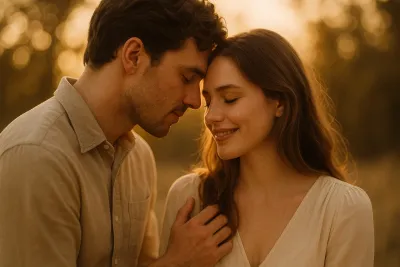
The problem with kissing your crush isn't the kiss. It's the seven hundred kisses you've already had with them in your head.
You know the ones. The shower kiss. The doorway kiss. The hallway-after-the-party kiss where they catch your hand and you both stop talking. By the time you actually get the chance to put your mouth near theirs, you're not approaching a person anymore. You're approaching a movie you've been editing in your head for the last three months. And no real person in the history of the world has ever managed to win against the imaginary version a brain in love has been building for that long.
This is the part nobody warns you about. The crush kiss is harder than a normal first kiss, and it's not because you don't know what you're doing. It's because you know too much about what you wanted it to be.
Let me tell you what's actually going on, and how to put yourself back in the room with the actual human being you actually like, instead of trapped in the highlight reel your brain has been running on loop.
Why Kissing Your Crush Is Its Own Specific Hell
A first kiss with someone new is a different animal than a first kiss with the one you've been thinking about. The new-person kiss has the easier kind of nervousness: you don't know them, so you can't disappoint them on a personal level. They're a stranger with kind eyes who you'll figure out in real time.
The crush kiss is a very different bargain. You've been building a private mythology around this person. You've ranked all the moments you've had together. You've revisited the eye contact at the coffee shop and the thing they said when their friend left the room. By the time you're standing in front of them with the chance on the table, you're carrying about forty pounds of accumulated meaning, and you're terrified you're going to drop the whole thing.
That weight is the problem.
The actual mechanics of the kiss aren't harder than any other kiss. The pressure is harder. And the pressure isn't coming from them. It's coming from the version of them you've been kissing in your head for weeks. The good news, and you're going to need this, is that the version in your head is the one you have to set down. The real one is the one you wanted in the first place.
The Lie Hollywood Sold You About This Specific Moment
Pop culture has trained an entire generation to believe the crush kiss should be a single, perfectly choreographed moment. Music swells. Rain optional. One of you puts a hand on the other's face. Eyes lock. Two clean inches close at the same speed. The kiss is wordless, slow, and somehow cinematic from every angle.
This is not a real thing.
Real crush kisses, the good ones, are almost always a little clumsy. There's usually a small awkward beat right before. Sometimes one of you laughs. Sometimes someone bumps a nose. Sometimes you almost kiss, pull back, and have to do it again three minutes later because the first lean-in didn't quite line up.
That clumsiness is not a failure of the moment. The clumsiness is the proof that you're both actually in the room. Two people who know what they're doing well enough for it to be smooth on the first try are usually two people for whom the moment doesn't matter that much. The first kiss with the person you've actually been losing sleep over is allowed to be a little uneven. It's supposed to be a little uneven. That uneven texture is half the reason you'll remember it.
If you walk into this expecting cinema, you'll spend the whole moment auditing yourself against a script that doesn't exist. Walk in expecting real, and the moment becomes available to you.
The Days and Hours Before: Stop Rehearsing
Most people prepare for kissing their crush by running the scene in their head one more time, then one more time, then one more. By the time the real moment arrives, the brain is so over-rehearsed it can't do anything except panic about deviating from the imaginary version.
Here's what I want you to do instead.
Stop kissing them in your head for the rest of the day. Every time the rehearsal starts up, redirect. Notice something in the room. Reread a sentence. Send a friend a text about something else entirely. The mental movie is not preparing you for the kiss; it's spending you for it. Save the energy for the actual moment.
Do the real-world prep, not the imaginary prep. Lip balm earlier in the day, not five minutes before. Brush your teeth before you head out and skip anything strong-smelling at dinner. Drink water. Bad breath is the silent kiss-killer and it's the easiest variable to control. The thing you can actually do for your future self is hand them a clean, ready body. Then leave the rest alone.
Plan the setting, not the script. A crush kiss has a much higher chance of happening when you've engineered a quiet enough moment for it to be possible. The walk somewhere with a stop in it. The drive home. The empty stretch of patio. You can't script what you'll say. You can absolutely choose to be in a place where two people could plausibly stop talking for ten seconds without it being weird.
Build the contact ladder before you build the kiss. Most failed crush kisses fail because the first physical contact of the night was the kiss itself. That's a huge cliff for two people to jump off of cold. The fix is to make sure casual touch happens earlier in the encounter: a hand on their back when you walk through a door, a knee touch under the table, a brief shoulder bump when you laugh. By the time you lean in for the kiss, your bodies have already had the conversation that they're allowed to be near each other. The kiss isn't a leap. It's a continuation.
Reading the Green Light From Someone You're Already Spiraling About
The trickiest thing about reading body language from someone you have a crush on is that you're trying to interpret signals through a wall of your own anxiety. Every glance gets coded as either they want me or they hate me with very little room in between, and your brain is incentivized to pick the worst reading because at least then you don't have to act.
Here's what to look for instead. The triangle gaze, when their eyes drop briefly from your eyes to your mouth and back up again, is the most reliable pre-kiss signal there is. So is the unconscious closing of physical distance: a person who keeps stepping a few inches closer to you over the course of a conversation is a person whose body is voting yes. So is the soft mirroring of your posture, your laugh, the way you're holding your drink. There's a longer breakdown of the eight signs someone wants to kiss you if you want to brush up.
The most underrated signal: the pause. When the conversation slows down and neither of you is rushing to fill the space. Most people interpret silence as they're not into me and start talking again to cover it. The opposite is true. The conversational lull is the most consistent green light there is. It's the moment the room is deciding what's going to happen next, and you don't fill it. You let it land.
If three or four of these are happening at once, you have your green light. The audit is finished. The next thing is the actual move.
The Five Seconds That Decide Everything
Most crush kisses are won or lost in the five seconds before the kiss happens, not during.
This is the part where overthinkers self-destruct. The signals have all lined up. The pause has happened. You can feel it in the room. And right at that moment, your brain serves up a buffet of catastrophic thoughts: what if I read it wrong, what if I lean in and they pull back, what if they laugh, what if I die.
What I want you to do, and this is the entire game, is slow down by half.
Hold the eye contact one beat longer than feels comfortable. Let yourself smile. Don't break the look to glance at their mouth and then back; the triangle gaze is something they do, not something you should perform. Just hold the eyes. Two seconds. Three.
Then close the distance slowly. Not in one swift romantic dive. In a leaning that takes long enough for them to either meet you or pull back. The slow lean is the kindest, most magnetic, most respectful version of the move. It gives them time to participate. It gives you time to read whether they're going to.
If they meet you halfway, you have your kiss. If they don't, you can stop without the whole thing crashing, because you weren't committed to a full lunge in the first place. The slow lean is its own form of asking. It's the version of consent that doesn't need words and doesn't kill the moment.
This is the move that separates people who panic into a kiss from people who are present for one. Practice the slow lean. It's worth more than any technique tip you'll ever read.
The Actual Kiss: Keep It Stupid Simple
This is the section where most articles will try to teach you a craft and ruin everything.
Don't do anything complicated. The first kiss with your crush is not the time to debut your repertoire. There is no tongue. There is no head tilt change halfway through. There is one motion, gentle, unhurried, and short.
The basics, and only the basics: lips slightly parted, soft enough to feel air, pressed for two to three seconds, then a small pull back with your eyes still closed for a half second longer than feels necessary. That last detail is the move. Eyes closed for the half-beat after the kiss communicates that you weren't rushing to evaluate it. You were inside it.
Then open your eyes. Smile, if a smile is true. Don't grin like you just won something; that breaks the spell. A small private smile is the right move. The kind that says yeah, that just happened, not I can't believe I got that.
If you find yourself going for tongue on a first kiss with your crush, especially within the first three seconds, pull yourself back. The crush kiss almost always works better as something restrained than as something that escalates fast. Restraint is what makes them spend the rest of the night thinking about the second one. The unhurried kiss is the most underrated move there is, and it's the right move here specifically.
If your brain wants more from you in the moment, the answer is not technique. The answer is hold a half-second longer. Press a fraction softer. Be slightly more present. That's the whole craft of a crush kiss.
After: Don't Ruin a Perfect Moment in the Next Sixty Seconds
You just kissed your crush. The kiss landed. Your brain is now going to try to demolish this in real time.
Do not apologize. Do not immediately ask if it was okay. Do not laugh in a self-deprecating way that signals you didn't think you deserved it. Do not grab your phone. Do not look at the floor. Do not say sorry, I just had to do that, which sounds romantic in a movie but reads as nervous in the actual aftermath.
What I want you to do is one of two things, and both work.
Option A: Say something specific. Not generic. Not that was nice. Something true and small. The way her hair just fell. The thing about his eyes. The fact that the moment finally happened. One sentence, said quietly, with the same eye contact you had two seconds ago. Specificity reads as presence. Generic compliments read as someone scrambling for a script.
Option B: Say nothing. Look at them. Don't break the eye contact. Maybe smile. Maybe move a piece of hair behind their ear. Let the silence carry the rest of the moment. Most people are too scared of post-kiss silence and rush to fill it. The pause is often the best part of the encounter, and it's where the intimacy actually crystallizes. You earn it by not flinching.
Then, depending on the situation, you either kiss them again or let the moment breathe and move on with the night. Both are correct. The wrong move is to perform something you don't feel because you think the script demands it. The post-kiss is its own art and it's worth taking seriously.
The Reframe That Saves You
Here's the one thing I wish someone had told me before my first attempt at a crush kiss.
They want to kiss you too. They've also been in their head about you. That's the whole secret of a crush: it's bidirectional unless one party actively shuts the door on it. By the time you've gotten close enough to plausibly kiss this person, the question of whether they wanted you to has already been quietly answered in their body for a while. You're not initiating something. You're catching up to something that's been happening.
The reason this matters is that most people walk into the crush kiss carrying a hundred percent of the responsibility for the emotional outcome. They believe they have to make this person feel something they don't already feel. That's not the assignment. The assignment is to confirm a feeling that's already in the room.
When you reframe it from I have to make this happen to I'm meeting them in the middle of something we've both already been doing, the moment gets easier in a way that's hard to describe until you feel it. You stop performing. You start participating.
That's the kiss they remember.
What If It Goes Sideways
Sometimes the kiss doesn't land. Sometimes you misread the signal. Sometimes you bump teeth, miss the angle, or kiss them on the corner of the mouth instead of the middle. The crush kiss has more chances of small awkward moments than almost any other kind of kiss, because the stakes are loaded.
Here's the thing nobody tells you: small awkward moments don't ruin crush kisses. The reaction to them does.
If you bump teeth, laugh once, briefly. Don't apologize ten times. Don't make it the rest of the conversation. The teeth-bump is a fine way for a first kiss to start. Plenty of long marriages began with one. The kiss after the laugh is usually the better kiss anyway.
If you misread the signal and they pull back, don't collapse. Lean back too. Smile. Say something normal. The moment didn't arrive yet; that's all the data point is. People who can take a soft no without crumbling are people who get more chances at yes. The grace under that moment is its own pull. They will remember how you handled it longer than they would have remembered the kiss itself.
The only true way to ruin a crush kiss is to spiral about it after it doesn't go perfectly. Awkwardness is recoverable. Self-flagellation isn't.
The Bottom Line
A crush kiss isn't a different kiss. It's the same kiss with louder mental noise around it. The whole craft of pulling it off is learning to turn that noise down enough to actually be in the room with the person you've been losing sleep over.
Stop rehearsing in your head. Build the casual contact ladder first. Read the slow signals, especially the pause. Lean in slow enough that they can meet you halfway. Keep the kiss itself simple. Hold the half-second after. Don't ruin the silence by filling it with apology.
And remember: they've been wanting it too. The reason they're your crush is that something already passed between you, in some small repeated way, over weeks. The kiss isn't the start of that. It's the moment you both stopped pretending it wasn't there.
The one in your head wasn't real. The one in front of you is. That's not a downgrade. That's the whole point.
Frequently Asked Questions
How do I know if my crush wants to kiss me back?
The most reliable signal is the triangle gaze, when their eyes drop from your eyes to your mouth and back, often unconsciously. Other strong signals are unprompted closing of physical distance over the course of the encounter, mirroring of your posture or movements, and the conversational pause where neither of you rushes to fill the silence. If you're seeing three or four of these signals at once, the chance is real. If you're not seeing any, the moment likely hasn't arrived yet, and forcing it usually doesn't help. There's a deeper read of the eight signs someone wants to kiss you here.
Should I tell my crush I like them before kissing them?
Not necessarily, and often it's better not to. A confession of feelings before a first kiss puts the whole weight of an emotional conversation on a moment that doesn't need it yet. The kiss itself, executed well, says enough. If you want to express something verbally, save it for after, and keep it specific and small. The exception is if you're misaligned in expectations, for example if a kiss might mean very different things to each of you. In that case, a brief, honest sentence about what you're feeling can clarify before things move forward.
What if I'm a worse kisser than my crush expects?
This worry is almost always overstated, and it's worth deflating. In my experience, warmth, presence, and paying attention matter far more than mechanics. People rarely judge a first kiss on technique. They judge it on whether they felt seen during it. If you're soft, present, and unhurried, you're already doing the part that matters. The actual definition of a good kisser is closer to a posture than a skill set, and you can hold that posture even on your first try.
Where should I kiss my crush for the first time?
Anywhere that gives you a quiet enough moment for it to be possible. The classic settings work because they engineer privacy: a walk, a drive, a quiet stretch of porch, the moment at a doorway, a slow stop on a street. Crowded loud places are not impossible, but they make the slow lean harder to execute and the post-kiss moment harder to inhabit. Wherever you choose, the rule is the same: a place where you can stop talking for ten seconds without anyone noticing or interrupting.
What if we bump teeth or noses?
Laugh once, briefly. Reset. Try again. A small physical mistake on a crush kiss is not a verdict on you or the connection; it's a side effect of two people being a little nervous about something they care about. The recovery is the move that matters. People who can take a small awkward moment in stride without making it the rest of the conversation are people whose second kiss is better than their first. The teeth bump is not the failure. The fifteen apologies after it would be.
Should I kiss my crush at school or work?
Probably not at work, and probably not in a public school hallway either. The setting matters for reasons beyond the kiss itself. A first crush kiss in an environment with social or professional stakes piles outside pressure on top of an already loaded moment, and the entire thing usually plays better in private. If your crush is a coworker or classmate, save the first kiss for a context that doesn't involve being watched by people who know you both. The privacy isn't about secrecy. It's about giving the moment room to be what it is.
How long should the first kiss with a crush last?
About two to three seconds. Long enough for both of you to register that it's happening. Short enough to leave them wanting the second one. The trap is going on too long with a first kiss, especially when nerves are pushing one or both of you to extend it as a way of proving something. Keep it short, pull back with your eyes still closed for a half-beat, and let the moment after the kiss carry as much weight as the kiss itself. The duration question gets more nuanced in established relationships, but for a first kiss, brevity is the move.