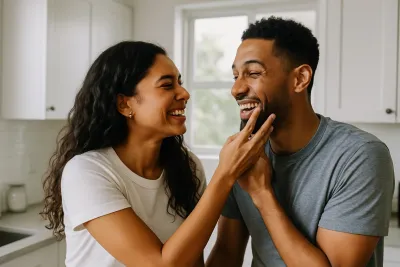
The first time I leaned in for a kiss, I led with my nose like a heat-seeking missile. Full collision. We both pulled back and laughed the kind of laugh that wants to crawl under a couch, then tried again. Nobody had warned me that two faces moving toward each other is, geometrically, a small traffic problem.
Here is the part that took me years to understand: the nose was never the issue. The panic about the nose was. And the fix is so small you will wonder why it ever kept you up at night.
Let me show you exactly what to do with your nose when kissing: where it goes, which way to turn, and how to stop thinking about it mid-kiss for good.
The Short Answer: What to Do With Your Nose When Kissing
You tilt your head slightly to one side. Your partner tilts theirs to the opposite side. Your noses slide past each other instead of into each other. That is the entire secret.
If you want it as a sequence:
- As you lean in, drop your eyes to their lips so you both know where this is going.
- Turn your head a few degrees to your right, which is most people's natural default.
- Let them mirror you by turning to their right, which is your left.
- Close the gap. Your noses pass cheek-side, your lips meet, and nobody gets a face full of forehead.
That is it. Not a maneuver. Not a move you need to rehearse in front of a mirror for a week. A tilt of maybe fifteen degrees, and the geometry solves itself.
The nose is the only part of the kiss you can see coming. That visibility is exactly why your brain overrates it.
Why the Nose Feels Like Such a Big Deal
Here is what nobody tells you: everyone is quietly worried about this. The nose question is one of the most common things people search before a first kiss, right next to where to put their hands and whether their breath passes inspection.
It feels enormous because it is the one part of the kiss you can see coming. Lips are forgiving. Tongues figure themselves out. But the nose sits right in the center of your face, leading the charge, and your brain files it as a liability.
It is not. Your nose is not too big, not in the way, and not about to ruin the moment. It is along for the ride, and it knows how to get out of its own way the second you stop steering it like a forklift.
The anxiety is the only real obstacle, which happens to be true of most first-kiss nerves in general. The body knows what to do the moment the mind stops filing incident reports.
Which Way Should You Tilt? Here's What the Research Says
This is my favorite piece of kissing trivia, and it is genuinely useful.
A bio-psychologist named Onur Gunturkun got curious about which direction people turn their heads to kiss. Instead of building a lab study, he spent his airport layovers doing something gloriously low-tech: watching strangers kiss in terminals, train stations, beaches, and parks across the United States, Germany, and Turkey. He logged 124 couples who made clean lip contact with empty hands.
The result: about 65 percent turned to the right. Only 35 percent went left. Roughly a two-to-one lean toward the right, and follow-up research keeps finding the same pull. It appears to start before we are even born and stick with us for life, wired in alongside the same machinery that sorts most of us into right-handedness. If you want the deeper version of why your body comes pre-loaded with these habits, the science of kissing goes all the way down that rabbit hole.
So your safest default is a gentle turn to your right. Odds are good your partner is built the same way and will drift to theirs, and the two of you slot together like you practiced.
One honest caveat: a later study found the rightward bias mostly shows up between people who already know each other. With total strangers, the very first kiss is closer to a coin flip. The takeaway is not to bet the whole moment on a statistic. Lead right, stay loose, and adjust to the actual human in front of you.
How to Tilt Your Head Without Overthinking It
The mistake is treating the tilt like a separate step you have to remember. It is not a checkbox. It is something you let happen.
Try it this way:
- Lead with your eyes, not your face. A glance down at their mouth does two jobs at once. It signals what you want, and it naturally drops your chin and angles your head. Half the tilt happens for free.
- Move slowly enough to course-correct. Speed is what causes collisions. A kiss approached at a calm pace gives both of you a half-second to read the angle and match it. Lunging deletes that buffer.
- Commit to one side. Pick a direction early and mean it. The wobble where you start right, second-guess yourself, and drift back to center is what actually causes the bump.
- Let your bodies mirror. People are wired to echo each other's movement. Turn your head and your partner will usually turn the opposite way without a single word spoken.
If you want this to feel automatic instead of theoretical, you can practice the motion on the back of your own hand. Sounds a little silly. Works anyway. The angle becomes muscle memory, and muscle memory does not get nervous.
What to Do When You Both Go the Same Way (The Nose Bump)
Sometimes you both pick the same direction and your noses meet in the middle. It happens to confident, experienced, objectively excellent kissers. It is not a verdict on you.
Here is the only correct response: smile. Maybe laugh, the good kind. Then tilt the other way and go again.
A nose bump is not a failure. Handled with ease, it is weirdly charming. It says you are present, you are human, and you are not so terrified of imperfection that one tiny collision unravels you. I have had nose bumps turn into better kisses than the smooth approaches, purely because the laugh dissolved the tension we were both carrying.
The people who get rattled are the ones who read it as proof they are bad at this. The people who recover already know the truth: nobody is keeping score except the anxious voice in your head, and that voice was never a reliable narrator.
Kissing With a Big Nose: The Part Nobody Says Out Loud
Let me be direct, because this is the search nobody admits to typing. If you think your nose is too big to kiss comfortably, you are wrong, and I can prove it with geometry.
A larger nose needs a slightly larger tilt. That is the whole adjustment. Turn your head a touch more than average, say twenty-five degrees instead of fifteen, and your nose tucks neatly alongside their cheek with room to spare. Bigger noses actually clear each other faster once you commit to the angle, because they leave the centerline sooner.
What sinks people is never nose size. It is the flinch: the half-tilt you do when you are self-conscious, hedging, trying to keep your face small. That hesitation causes the exact bump you were afraid of, which then confirms the fear, and round and round it goes.
Own the angle. Turn your head like you have done it a thousand times. Confidence here is not a personality trait you were born with. It is a fifteen-degree decision you make with your neck.
Confidence at the moment of the kiss is not a trait. It is a fifteen-degree decision you make with your neck.
Glasses, Beards, and the Stuffy-Nose Problem
A few real-world wrinkles worth a quick word.
If you wear glasses, the tilt pulls double duty, because the same turn that saves your nose also keeps your frames from clashing. There is a bit more to it, which is why kissing with glasses on earns its own playbook.
If you are kissing someone with facial hair, the nose matters less and the angle matters more, since you are working around slightly different terrain near the mouth. Kissing someone with a beard comes with its own small adjustments worth knowing.
And if your nose is stuffed up, do not hold your breath until you see stars. Part your lips a little and breathe through your mouth between contact. The mechanics of breathing while kissing are simpler than they feel, and a blocked nose is never a reason to bail on a good moment.
The Bonus Move: Make Your Nose Part of the Kiss
Here is the reframe that changes everything. Your nose is not a problem to hide. It can be part of the language.
Before your lips meet, brush your nose lightly against theirs. A slow nose-to-nose graze, foreheads apart, eyes half-open. People call it an Eskimo kiss, and it is pure anticipation. It says I am here, I see you, and I am in no rush. That pause stretches the moment until the actual kiss lands like a release. (A kiss on the tip of the nose says something else again, and I decoded it in what a kiss on the nose means.)
Pull back after a kiss and rest your nose against theirs for a beat, and you have turned the thing you were scared of into one of the most tender notes in the whole exchange.
The nose was never in the way. It was waiting for you to give it something to do.
That is the whole truth about your nose. Tilt slightly, usually right, move slow enough to adjust, and laugh it off if you bump. The geometry is easy. The confidence is the part worth building, and it grows faster than you would believe.
If you want the rest of the small mechanics nobody bothers to explain, the kind that quietly separate a forgettable kiss from one someone replays all week, that is exactly what I wrote The 10 Kiss Commandments for. Grab the free chapter below. Your nose, for the record, is going to be just fine.
Frequently Asked Questions
Do most people tilt left or right when they kiss?
Right. In an observational study of 124 kissing couples across three countries, about 65 percent turned their heads to the right and only 35 percent went left. The bias appears to be wired in alongside right-handedness and shows up before we are even born. One caveat: between total strangers, the very first kiss is closer to a coin flip, so lead right but stay ready to adjust.
How do you avoid bumping noses when you kiss?
Tilt your head about fifteen degrees to one side as you lean in, and let your partner mirror you by tilting the other way. Your noses slide past each other instead of colliding. Move slowly enough to course-correct, commit to one side early, and drop your eyes to their lips first, which naturally angles your head for free.
Can you kiss comfortably if you have a big nose?
Yes. A larger nose just needs a slightly larger tilt, closer to twenty-five degrees instead of fifteen, and it tucks neatly alongside your partner's cheek. Bigger noses actually clear each other faster once you commit to the angle, because they leave the centerline sooner. What causes bumps is the hesitant half-tilt people do when they feel self-conscious, not nose size.
What should you do if you bump noses mid-kiss?
Smile, maybe laugh, then tilt the other way and go again. A nose bump happens to confident, experienced kissers and says nothing about your skill. Handled with ease, it is even charming, because it shows you are present and not rattled by imperfection. The only way it ruins the moment is if you freeze or start apologizing.