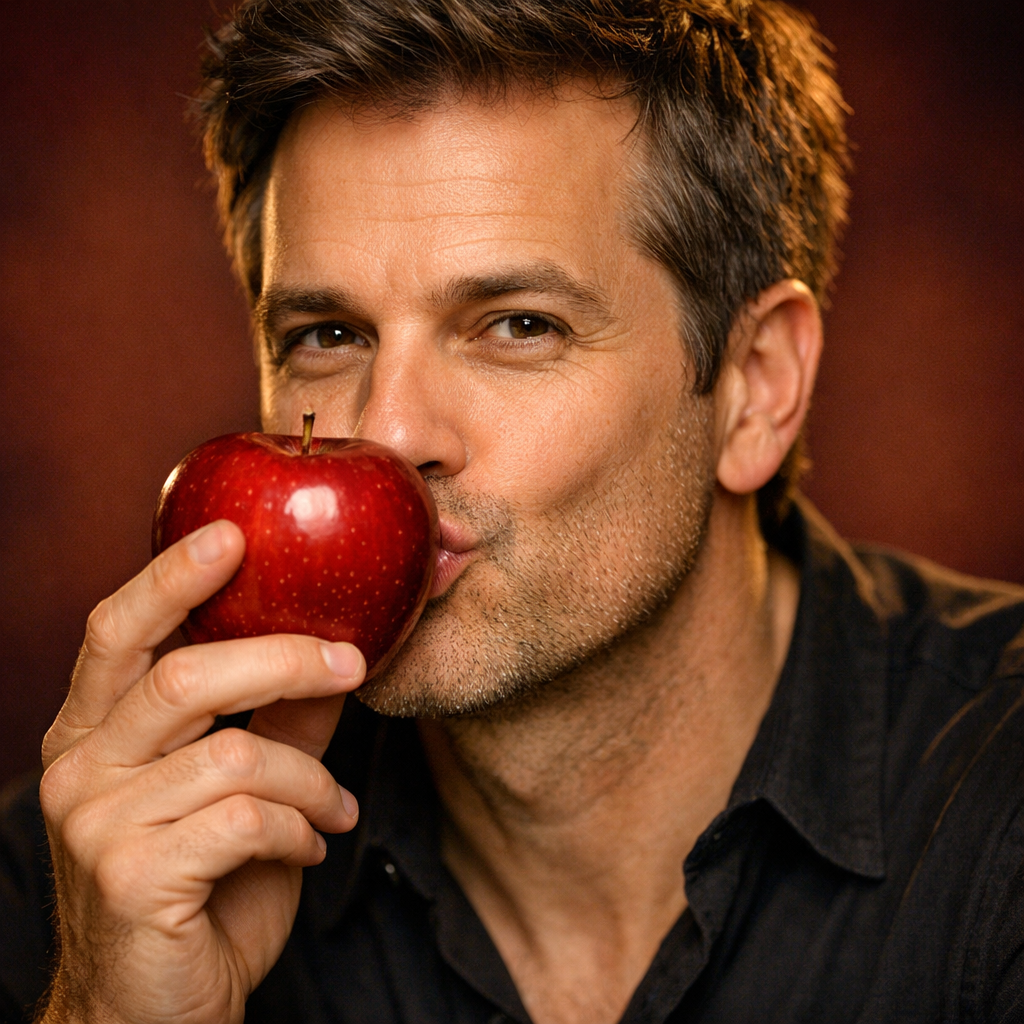
Your lips are liars. Not in the way you're thinking.
They've been convincing you that kissing is just about technique, or chemistry, or some mystical spark you either have or don't. But the truth is far more interesting: your lips are biological marvels, engineered by millions of years of evolution to be the most sophisticated sensory instruments on your body.
Understanding their anatomy won't just satisfy your curiosity. It will change how you kiss.
The Nerve Density That Changes Everything
Here's a number that should stop you cold: your lips contain roughly one million nerve endings.
To put that in perspective, your fingertips (famous for their sensitivity, essential for reading Braille, praised by safe-crackers everywhere) have about 2,500 nerve receptors per square centimeter. Your lips? They're packing around 100 times that density in certain areas.
This isn't an accident. Evolution built your lips to be the body's first line of sensory contact with the outside world. Before language, before tools, before we figured out fire, our ancestors were using their lips to test temperature, detect texture, identify edible versus poisonous. Your lips are ancient instruments of survival, repurposed for pleasure.
The practical implication is profound: your lips can detect sensations your fingers would miss entirely. A featherlight brush. A slight change in temperature. The texture difference between the edge of someone's lip and its center. Your lips register all of it.
Why Lip Skin Is Different (And What That Means)
Run your tongue along the inside of your cheek, then across your lips. Notice the difference? Your lips feel smoother, almost slick compared to the rest of your mouth.
That's because lip tissue is unique. Regular skin has about 16 layers of cells between you and the world. Lip skin? Three to five layers. That's it.
This extreme thinness serves a purpose. Those million nerve endings need to be close to the surface to do their job. Thick skin would muffle the signals like wearing oven mitts to play piano. Your lips traded protection for sensitivity, and the exchange rate is staggering.
This is also why lips are red (or pink, or darker shades depending on your complexion). You're seeing blood vessels through that thin tissue. The same thinness that makes lips vulnerable to chapping and sun damage is what makes them exquisitely responsive to touch.
The Vermilion Border: Your Secret Weapon
There's a specific zone on your lips that most people ignore entirely but holds disproportionate power: the vermilion border.
This is the sharp edge where the colored part of your lip meets regular skin. Look in a mirror and trace it with your eyes. That precise line, that transition zone? It has the highest nerve concentration of anywhere on your lips.
When someone traces a finger along that edge, the sensation registers with almost startling intensity. When lips brush against this border during a kiss, the signal floods the brain with information. This tiny anatomical feature punches far above its weight.
Great kissers, whether they know the term or not, instinctively pay attention to this zone. They let their lips drift to the edge. They don't just mash center-to-center like they're trying to resuscitate someone.
Your Brain's Obsession With Your Lips
If you've ever seen a diagram of the "sensory homunculus," you know it looks absurd. It's a distorted human figure drawn to represent how much brain space each body part occupies on your sensory map. The lips? Enormous. Grotesquely large compared to the torso, the legs, the back.
Your brain dedicates a wildly disproportionate amount of processing power to your lips. More than your entire back. More than both legs combined. Almost as much as your hands.
This means every signal from your lips gets premium treatment. The neural pathways are thick and fast. The processing centers are oversized and eager. When your lips experience something, your brain pays attention.
This is why a kiss can feel like it takes over your entire consciousness. It's not just poetry. It's architecture. Your brain is literally built to prioritize lip sensation above almost everything else.
Light Touch Beats Heavy Pressure (Here's Why)
Most people kiss too hard.
I don't mean they're aggressive or forceful (though some are). I mean they apply consistent, sustained pressure when the anatomy of lips actually rewards the opposite.
The nerve endings in your lips are tuned to detect change. Variations in pressure. Shifts in temperature. Movement across texture. When you press hard and hold, you're giving those receptors a single sustained signal. Interesting at first, then rapidly boring.
When you kiss with varying pressure, pulling back to almost nothing then returning, dragging lips lightly across each other, pausing to let breath be the only contact, you're feeding those nerve endings exactly what they crave. Novelty. Variation. Information.
This is why the best kissers create texture. They understand (consciously or not) that lips respond to patterns, not pressure.
The Temperature Factor
Your lips don't just detect touch. They're exquisitely sensitive to temperature, more so than anywhere else on your body outside your tongue.
This sensitivity evolved for safety (hot food would burn your mouth without early warning) but it has delightful side effects. The warmth of another person's breath before contact. The slight coolness when they pull back and air rushes in. The heat that builds when mouths stay pressed together.
Skilled kissers play with this. They let the anticipation build, breathing close without touching. They alternate between warm, lingering contact and brief separations. Every temperature shift registers as sensation, adding layers to the experience your brain eagerly processes.
What This Means For How You Kiss
Understanding lip anatomy transforms kissing from mysterious to logical. Not in a clinical way. In a "now I know why that works" way.
Start lighter than you think. Those densely packed nerves need gentle input to shine. The brush of lips barely touching creates more sensation than a full-contact press. Build from whisper-soft.
Vary everything. Pressure, angle, pace, even temperature. Your partner's lips are constantly searching for new information. Give them something to find. The moment you fall into a repetitive pattern, those nerve endings start tuning out.
The edges matter. Don't just aim for center-to-center contact. Let lips drift. Explore corners. Let the vermilion border do its work. When your lips brush across theirs (instead of just pressing into them), you're maximizing the anatomical advantage.
Pause deliberately. That massive brain investment in lip sensation? It doesn't shut off when contact stops. The absence of touch, especially after you've built anticipation, creates its own powerful experience. The breath, the warmth, the almost-but-not-quite. These pauses might be more intense than the kissing itself.
"Your lips were built to feel everything. The question is whether you're giving them something worth feeling."
The Evolutionary Accident That Makes Kissing Electric
Here's the thing: lips weren't designed for kissing. Not originally.
They evolved for eating, for protection, for communication before words existed. The fact that pressing them against another person's mouth creates such profound sensation is almost an accident. A beautiful, fortunate accident that our ancestors discovered and we've been refining ever since.
Your lips are survival equipment repurposed for connection. Every nerve ending that once kept your ancestors from burning their mouths now translates into pleasure when you kiss someone you want. For more on the chemistry and neuroscience behind all of this, read our deep dive into the science of kissing.
Knowing this changes nothing about the magic. If anything, it deepens it. Those million nerve endings don't care about the evolutionary history. They just respond to what's happening right now, in this moment, with this mouth against this mouth.
The anatomy explains why kissing works. It doesn't explain why it matters. That part is still yours to feel, impossible to diagram, irreducible to neurons.
But at least now you know what your lips are capable of. And maybe, with that knowledge, you'll give them something worthy of their extraordinary design.
Frequently Asked Questions
Why are lips more sensitive than fingertips?
Lips contain roughly one million nerve endings packed into a very thin layer of skin (just 3-5 cell layers thick), giving them about 100 times the nerve receptor density of fingertips. This extreme sensitivity evolved to help our ancestors test food temperature and detect textures before eating.
What is the vermilion border and why does it matter for kissing?
The vermilion border is the sharp edge where the colored part of your lip meets regular skin. It has the highest nerve concentration of anywhere on your lips, making it extraordinarily responsive to touch. Great kissers instinctively pay attention to this zone rather than just pressing center-to-center.
Why does light touch feel better than heavy pressure when kissing?
The nerve endings in your lips are tuned to detect change rather than sustained pressure. Varying pressure, pulling back to almost nothing then returning, and dragging lips lightly across each other feeds those nerve endings exactly what they crave: novelty, variation, and information.
Why does the brain dedicate so much processing power to lips?
The sensory homunculus shows that your brain dedicates a wildly disproportionate amount of processing power to your lips — more than your entire back and both legs combined. This means every signal from your lips gets premium neural treatment, which is why a kiss can feel like it takes over your entire consciousness.