French kiss vs normal kiss: the whole difference comes down to about half an inch of jaw and one decision.
Lips together, it's a normal kiss. Lips parted, tongue invited, and the same two people in the same doorway are suddenly having a very different conversation.
You probably knew tongue was involved before you searched. What you actually want is everything around it: what the kisses in between are called, whether an open-mouth kiss already counts as French, which one belongs where, and how to cross from one to the other without the moment turning into a dental exam.
Here's the whole map, from the quick peck to the full French, plus the one move that gets you across the line gracefully.
French Kiss vs Normal Kiss: The Short Answer
A normal kiss is a closed-mouth kiss. Lips meet, press, part. A French kiss is an open-mouth kiss with tongue. Merriam-Webster draws the line in the same place, defining a French kiss as an open-mouth kiss usually involving tongue-to-tongue contact.
That's the mechanics. The bigger difference is what each kiss says.
A normal kiss is a sentence: hello, goodbye, I'm glad you're mine. A French kiss is a conversation, and the topic is wanting each other.
Here's the side-by-side:
- Mouth: closed or barely parted for a normal kiss; open and relaxed for a French kiss.
- Tongue: none, versus some. (Less than you think. More on that below.)
- Pace: quick or still, versus slow and shifting.
- Length: a beat or two, versus as long as it stays good for both of you.
- Where it works: almost anywhere, versus somewhere you'd be comfortable getting lost for a minute.
- What it signals: affection, versus desire.
Neither one is the "real" kiss. They're different tools, and the people who kiss best know when to reach for which.
What Counts as a Normal Kiss?
"Normal kiss" isn't an official term, which is why people search for it so many ways: simple kiss, lip kiss, regular kiss, closed-mouth kiss, smooch. They all point to the same family, and the family has three main members.
The peck. Fast, light, closed. The kiss of hellos and goodbyes and grab milk on the way home. It's over almost before it starts, and that's the point. A peck can carry a surprising amount of meaning depending on who gives it; I broke that down in what a peck on the lips means.
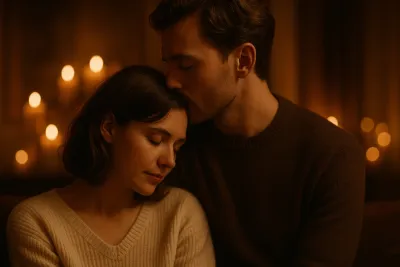
The closed-mouth kiss. Still no tongue, but slower. Lips press, shift slightly, maybe take the top lip and then the bottom one. This is the kiss most first kisses are made of, and there's real craft in it.
The lingering kiss. A closed-mouth kiss that refuses to end on schedule. Nothing escalates. It just stays. Stillness can feel more intimate than any tongue, which is why a lingering kiss often lands harder than a French one.
Here's what nobody tells you: the normal kiss isn't the training-wheels version. With the mouth closed, your lips do all the work, and your lips are packed with sensitive nerve endings. Every small change in pressure gets noticed. Sloppiness has nowhere to hide.
Simple is not the same as easy.
What Makes a Kiss a French Kiss?
Two things: the mouth opens, and tongues meet.
But the word "tongue" scares people into picturing far more of it than a good French kiss contains. A French kiss is still mostly lips. The tongue is a guest that drops by, says hello and steps back out. It does not move in and start rearranging the furniture. I go deeper on the ratio in where to put your tongue when kissing, but the short version is lips first, tongue as the accent.
There's also a physical difference beyond the obvious one. A team of Dutch researchers who studied 21 couples estimated that a single ten-second kiss with full tongue contact moves around 80 million bacteria from one mouth to the other. Couples who shared nine or more of those kisses a day also had significantly more similar saliva bacteria.
A normal kiss is a touch. A French kiss is an exchange. Your mouth knows the difference, even if nobody's counting microbes.
That's also why a French kiss asks more of the moment: fresher breath, more trust, more privacy, and two people who both want the same thing. If you're curious what else is going on in your body during all this, the science of kissing covers it.
The Kiss in the Middle: Open-Mouth Without Tongue
This is the kiss most guides skip, and it's the one that makes everything else work.
Lips part. Mouths relax and open slightly. The kiss gets slower and fuller, lips folding into each other, but no tongue has shown up yet. Some people call it a lip lock. Some call it a deep kiss. Most people don't call it anything, which is exactly why "is open mouth kissing French kissing" gets typed into search bars.
Does it count? Technically, not quite. The dictionary definition says open mouths and usually tongue, so an open-mouth kiss without tongue sits right on the border. In everyday speech, most people only say "French kiss" once tongues touch.
Practically, this middle kiss is the bridge. A lot of awkward first French kisses go wrong right here: someone jumps from closed lips straight to full tongue and skips the bridge entirely. The open-mouth kiss is where two people agree on a rhythm before anything wetter happens. If you want to get properly good at it, kissing without tongue is the skill to practice.
Kissing vs Making Out: Where the Line Actually Is
People mix these up all the time, because they're different kinds of thing.
French kissing is a type of kiss. Making out is a session. A makeout usually includes French kissing, but it also includes normal kisses, pauses, kisses along the jaw and neck, hands, laughing and starting again. It's the whole evening's weather, not one cloud.
You can French kiss someone for ten seconds at a party and not have made out. You can make out for twenty minutes and spend half of it on slow closed-mouth kisses. For the full arc of a session, how to make out walks through it from start to finish.
Which Kiss Fits Which Moment
The best kissers aren't the ones with the fanciest tongue work. They're the ones who pick the right kiss for the room. A rough guide:
- Hello and goodbye: normal kiss. A peck at the airport curb says everything it needs to.
- In public: normal kiss, maybe a lingering one. Save the French for somewhere without an audience.
- A first kiss: start normal. Let it open up if you both lean in. Tongue, if it shows up at all, should arrive late and politely; I made the full case in should you use tongue on a first kiss.
- The end of a great date: a closed-mouth kiss that lingers often beats an ambitious French kiss on a doorstep.
- Alone with someone who is clearly kissing you back: French kiss territory.
- New braces: normal kisses first. Kissing with braces works fine, but the open-mouth part takes some adjusting.
- A long-term relationship: both, on purpose. Don't let the French kiss quietly retire just because pecks are easier. A real one on an ordinary Tuesday costs nothing and says plenty.
How to Go From a Normal Kiss to a French Kiss (Without Making It Weird)
Here's the move I'd teach a friend. I call it The Knock, because the tongue knocks before it comes in.
- Start with a normal kiss. Closed mouth, slow. Give it a few kisses to settle into a shared rhythm.
- Soften your jaw. Let your lips part slightly. Not a yawn; just enough that the kiss gets fuller, not wider.
- Wait for them to match. If their lips part too, you're both in the open-mouth kiss. If they stay closed, stay where you are.
- Knock. Let the tip of your tongue lightly touch their lower lip or the tip of their tongue, for a second at most.
- Retreat. Pull your tongue back and return to lips. This is the step almost everyone skips, and it's the one that makes the kiss feel like an invitation instead of an invasion.
- Let them answer. If their tongue comes looking for yours, meet it, lightly and briefly. If it doesn't, keep kissing with your lips and leave the door closed.
- Keep breathing through your nose. Everything slows down once tongues are involved, so breathe while you kiss instead of holding it.
It's the famous rule from Hitch, scaled down to tongue size: go 90 percent of the way, then hold, and let them come the other 10.
Want a rehearsal before the real thing? Practicing kissing by yourself can help with lip control, though reading another person only comes from kissing one. And once you're past the knock, how to French kiss covers pace, pressure and what your tongue should do next.
How to Tell Which Kiss They Want
You don't need to guess. Mouths are honest.
Signs they'd welcome a French kiss:
- Their lips part and stay parted.
- The kiss slows down instead of ending.
- They lean further in, or pull you closer by the waist, the jaw or the shirt.
- Their breathing changes and they don't pull back to talk.
- Their tongue touches your lip first. That's not a hint. That's an RSVP.
Signs they'd rather keep it a normal kiss:
- Their lips stay firm and closed.
- The kisses stay short, with little breaks in between.
- They ease back half an inch, laugh or start talking.
- Their body stays still or turns slightly away.
If the signals are mixed, slow down, not up.
Let me be direct: if you honestly can't tell, ask. "Can I kiss you properly?" said quietly, with half a smile, is one of the most attractive sentences in the language. And whatever they answer, the answer is the right one.
People have real tongue preferences, and they're allowed to keep them. One of the ten questions in the Kiss Test is literally "Tongue. What's your policy?" because the honest answers vary that much.
Why Is It Called a French Kiss?
Blame the English speakers.
According to NPR's reporting, the term is commonly attributed to American soldiers coming home from World War I. Merriam-Webster dates the phrase to 1922.
The French, meanwhile, went centuries without one tidy word for it. They had phrases instead, plus slang like rouler une pelle, which translates to roughly "roll a shovel" and is not the most seductive image ever assembled. Then the 2014 edition of Le Petit Robert, the French dictionary, added galocher: to kiss with tongues.
The root is galoche. NPR described it as a word for an ice-skating boot, which evokes sliding around on ice; The Local translates it as an overshoe. Either way, the French named the kiss after footwear doing something slippery. Frankly, fair.
Which Is Better: A Normal Kiss or a French Kiss?
Neither. And both.
A French kiss with no normal kisses around it is all dessert and no dinner. A relationship running only on pecks is a kitchen nobody cooks in anymore.
The best kissers move between them like a tide: in, out, closed, open, slow, slower. They start with lips, let the mouth open when the moment opens, let the tongue visit, then come back to a closed-mouth kiss to finish. That last part matters more than people think. Ending a French kiss with one small, normal kiss is like signing your name at the bottom of a letter.
If you want the rest of the lineup, I decoded 21 types of kisses and what they mean in one place.
Lips first. Tongue by invitation. Always come home to a normal kiss.
Frequently Asked Questions
What is a normal kiss called?
There's no single official name. People call a kiss without tongue a peck, a closed-mouth kiss, a lip kiss, a simple kiss or a smooch. "Normal kiss" is just the everyday way of describing a kiss where the lips touch and the mouths stay closed.
Is a French kiss always with tongue?
Almost always. Merriam-Webster defines it as an open-mouth kiss usually involving tongue-to-tongue contact, and in everyday use, tongue is what turns a kiss into a French kiss. A good French kiss is still mostly lips, with the tongue used lightly.
Is open-mouth kissing the same as French kissing?
Not quite. An open-mouth kiss without tongue sits between a normal kiss and a French kiss. It's often the stage right before a French kiss, and most people only call it French once tongues touch.
Is a lip lock a French kiss?
Usually not. People use "lip lock" for a long kiss on the lips, often with the mouths slightly open but no tongue. Once tongues meet, most people would call it a French kiss.
What's the difference between a peck and a kiss?
A peck is one type of kiss: quick, light and closed-mouth, usually over in a second or so. A fuller kiss lasts longer, uses more pressure or movement, and can be closed-mouth, open-mouth or French.
What's the difference between kissing and making out?
Kissing can mean a single kiss of any type. Making out is a longer session that usually mixes French kisses with normal kisses, pauses, touching and kisses along the jaw or neck. French kissing is a kind of kiss; making out is what happens when you keep going.
Is a French kiss more romantic than a normal kiss?
More intense, not automatically more romantic. A French kiss signals desire. A slow closed-mouth kiss or a lingering peck can feel just as romantic, sometimes more, because nothing about it is rushing toward the next step.
Should a first kiss be a French kiss?
Usually not right away. Start with a normal, closed-mouth kiss, let it open up if you both lean in, and bring tongue in lightly only if they respond. Plenty of great first kisses never get to tongue at all.