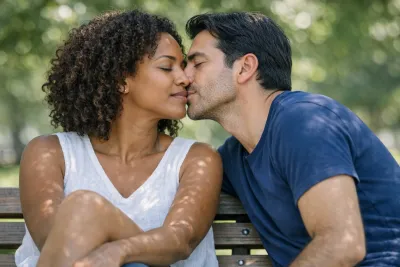
Your lips touch someone else's. It lasts a few seconds. Maybe a few minutes if you're lucky. And in that time, your body runs a biological marathon you never asked for.
Most people think kissing is emotional. Romantic. A nice thing humans do. And it is all that. But it's also a full-body physiological event that rewires your brain chemistry, resets your cardiovascular system, and floods your bloodstream with compounds powerful enough to rival prescription medication.
That's not metaphor. That's research.
Here's what actually happens inside you when you kiss someone, and why understanding it might change the way you think about every kiss from now on.
Your Brain on a Kiss (The Chemical Cocktail)
The moment your lips make contact, your brain fires up like a switchboard. Within milliseconds, your somatosensory cortex (the part that processes touch) lights up, and it has good reason to: your lips contain over 100 times more nerve endings than your fingertips. Every micromovement registers.
But the real story is in the chemistry.
Your brain releases a surge of dopamine, the same neurotransmitter that spikes when you eat chocolate, win money, or hear your favorite song. It's the "I want more of that" chemical, and it's why good kisses feel slightly addictive. You're not imagining the pull. Your reward circuitry is literally activating.
Simultaneously, your brain dumps oxytocin into your bloodstream. Oxytocin is the bonding hormone: it creates feelings of attachment, trust, and emotional closeness. This is why a kiss can feel like it changes something between two people. Neurochemically, it does.
Then there's serotonin. Kissing elevates serotonin levels, which contributes to feelings of well-being and happiness. And adrenaline kicks in too, which is why your heart rate increases and your palms might sweat. Your body is experiencing a controlled rush: the same neurological pathway as excitement, just routed through your lips.
The full neuroscience goes even deeper, but the short version is this: a single kiss triggers at least four major neurotransmitter systems simultaneously. Very few human experiences do that.
Your Heart Doesn't Just Race. It Recalibrates.
You know the feeling: your heart speeds up during a kiss. Most people assume that's just excitement. It is. But there's something more interesting happening underneath.
Oxytocin, which kissing releases, can relax your blood vessels. Nobody has checked whether that lowers blood pressure in kissers, but a 2009 study in the Western Journal of Communication found that couples who increased their kissing frequency over six weeks showed measurable decreases in total serum cholesterol.
Read that again. Kissing lowered their cholesterol. Not exercise. Not diet changes. Kissing.
The same study found improvements in perceived stress and relationship satisfaction. The researchers were careful to say more work is needed before anyone prescribes kissing, but I love this result.
Scientists basically assigned couples homework to kiss more.
Your heart rate increases during the kiss itself (that's the adrenaline), then it settles once the kiss is over. It's like a micro-workout followed by a deep cool-down.
Your Immune System Gets a Workout
Here's where it gets wild.
A single 10-second French kiss transfers roughly 80 million bacteria between partners. That sounds alarming until you hear what it might do: give your immune system a little practice.
Some researchers think this exchange might work a little like a natural vaccination, though nobody has proven it. The idea is that your body meets new organisms in small doses and learns to handle them. Over time, couples who kiss regularly develop similar oral microbiomes: their bodies essentially sync up their bacterial communities.
A 2014 study published in the journal Microbiome found that couples who kissed at least nine times per day had the highest level of shared bacteria. The researchers weren't recommending a quota; they were documenting a biological reality. The more you kiss someone, the more your mouths start to look alike, bacterially speaking.
There's also a cortisol angle. Elevated cortisol (the stress hormone) suppresses immune function. Since kissing seems to lower cortisol, it may give your immunity an indirect assist through plain old stress reduction. Not bad for something your lips started.
The Stress in Your Body Dissolves (Literally)
Cortisol is the villain in this story, and kissing is remarkably effective at shutting it down.
When you're stressed, cortisol floods your system. It increases heart rate, raises blood sugar, suppresses digestion, and weakens immune function. It's designed for emergencies, not for daily living. But modern life keeps the tap running.
Kissing seems to turn that tap down. In a small Lafayette College study, cortisol dropped in both partners after kissing. Nobody has pinned down exactly why yet.
That 2009 study I mentioned? The couples who kissed more said they felt less stressed, and their blood work, measured by Kory Floyd's team, showed lower total cholesterol. Not a vibe. A lab result.
This is why a six-second kiss at the start or end of each day isn't just a nice relationship habit. It's the cheapest stress break I know.
Your Face Gets a Workout (Seriously)
How many facial muscles a kiss uses depends on how much you put into it. A gentle peck uses your orbicularis oris (the muscle ring around your mouth). A full, passionate kiss recruits muscles in your jaw, cheeks, and tongue.
Vigorous kissing does burn a few extra calories. That's not going to replace your gym membership, but it's more than sitting on the couch. And unlike the treadmill, nobody has ever described kissing as something they dread but do anyway.
The facial muscle engagement has another side effect: increased blood flow to the face, which promotes collagen production. Some dermatologists have noted that regular kissing could contribute to firmer, healthier-looking skin over time. The evidence is anecdotal, but the mechanism is plausible. Anything that increases blood flow to your face is doing your skin a favor.
The Pain Relief Nobody Talks About
This one surprises people. Kissing has analgesic properties.
The endorphins released during kissing function as natural painkillers. They work on the same neural pathways as morphine (at a much lower intensity, obviously). But the effect is real and measurable: kissing can reduce the perception of headaches, menstrual cramps, and even minor aches and pains.
The vasodilation from oxytocin also helps. When blood vessels widen, blood flow increases, and muscle tension decreases. Cramps (which are essentially sustained muscle contractions) get relief from improved circulation.
So the next time someone says "not tonight, I have a headache," the science suggests kissing might actually help. (Use this information responsibly.)
The endorphin release also creates a mild euphoria: that floaty, warm feeling you get during and after a particularly good kiss. It's not imagination. It's your body's own opioid system doing exactly what it was designed to do.
What a Six-Second Kiss Actually Does
Relationship researcher John Gottman recommends a six-second kiss at the start and end of each day. Most people hear this and think it's about emotional connection. It is. But I'd bet the biology in this article is part of why it works.
Nobody has timed it in a lab, but six seconds at least gives the good stuff in this article room to start: the dopamine and oxytocin, a little less stress, a real microbial exchange, your facial muscles fully engaged.
Six seconds. Call it my minimum effective dose.
How long a kiss lasts matters more than you'd think: most casual kisses are over in a couple of seconds. That's barely a hello. Six seconds is where a kiss starts to feel like a kiss.
Kissing slowly and deliberately isn't just more romantic. It gives your body time to do what it's trying to do. Speed kills the benefits. Presence amplifies them.
The Dark Side (Because Honesty Matters)
Honesty requires mentioning this: kissing can also transmit illness. Cold sores (HSV-1), mono (Epstein-Barr virus), colds, and flu all spread through saliva. If you or your partner is sick, kissing isn't the move.
A 2025 study made headlines when researchers found that partners of people with depression or anxiety showed increased symptoms after six months. The news cycle ran with "kissing spreads depression," but the study only showed a link: the researchers think shared mouth bacteria might play a part, and that hasn't been confirmed. Either way, it's a good reminder that partners share a lot more than a bed.
The immune system benefits work in your favor most of the time. But they require both people to be reasonably healthy. The same microbial exchange that strengthens immunity can introduce pathogens when someone's actually sick. Common sense applies.
Why This All Matters for How You Kiss
You didn't come here for a biology lecture. You came because you want to kiss better. So here's the actionable takeaway:
Presence triggers the cascade. Every benefit on this list requires you to actually be in the kiss. A distracted peck doesn't release much oxytocin. A rushed goodbye doesn't lower cortisol. The neurochemistry responds to quality and duration, not just contact.
Duration matters. Longer, slower kisses produce more of every beneficial compound. Not because longer is automatically better, but because your brain needs a few seconds to shift into the right gear.
Frequency compounds. The couples in these studies didn't get one magic kiss. They kissed more often. The benefits accumulated over time. Daily kissing is a health habit with more scientific support than half the supplements people buy online.
Intention amplifies everything. When you kiss someone with genuine attention, when you feel their lips and respond to what's happening in real time, your somatosensory cortex lights up brighter. More neural engagement means more neurotransmitter release means more of everything on this list.
The people who dismiss kissing as "just kissing" are missing the point. Your body treats a good kiss like a full-system reset: neurological, cardiovascular, immunological, and emotional. All from something that costs nothing, takes seconds, and feels extraordinary.
The only requirement is that you actually show up for it.
Frequently Asked Questions
Does kissing burn calories?
Yes, though modestly. Vigorous kissing burns a few extra calories and works more facial muscles than you'd guess. It will not replace exercise, but the increased blood flow to your face may also support collagen production, which is a nicer side effect than anything a treadmill offers.
Can kissing really lower blood pressure and cholesterol?
Cholesterol, possibly. Blood pressure hasn't been tested, though oxytocin can relax blood vessels. A 2009 study in the Western Journal of Communication found that couples who kissed more often over six weeks showed measurable drops in total serum cholesterol, along with lower perceived stress. The researchers called for more studies before anyone treats kissing as a health intervention.
Is kissing good for your immune system?
Possibly. A 10-second French kiss transfers roughly 80 million bacteria, and some researchers think that exchange may gently train your immune system, though it hasn't been proven. A 2014 study in the journal Microbiome found that couples who kissed frequently developed similar oral microbiomes. Kissing may also lower cortisol, and since high cortisol suppresses immune function, that's a second possible route to the same benefit.
How long does a kiss need to last for the health benefits?
About six seconds, though nobody has measured an exact threshold. Most casual kisses are over in a couple of seconds, which is barely long enough to register. Relationship researcher John Gottman recommends a six-second kiss at the start and end of every day.