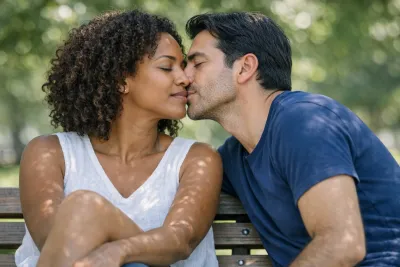
Somewhere around the third date, it happens. You're mid-kiss, everything is going beautifully, and some ancient instinct tells you to peek. You crack one eye open.
Theirs are already open.
Not dreamy, half-lidded, movie-poster open. Fully open. Watching you from an inch away, at a distance where you can count their eyelashes and they can count yours.
Few kissing quirks rattle people like this one, and the internet's answers are terrible: half superstition, half accusation, all guesswork. Time for real ones. Here's what kissing with your eyes open actually means, when it matters, when it doesn't, and the one version of it that isn't a red flag at all. It's a move.
What kissing with your eyes open actually means
The short answer: kissing with your eyes open is not, by itself, evidence of anything sinister. It almost always traces back to one of seven causes, and the most common ones are flattering. They're taking you in. They're curious. Or their brain simply doesn't need to cut the lights to feel a kiss. The unflattering versions exist too, but they announce themselves through the hands, the breath, and the body, never the eyelids alone.
You've probably heard the old warning: never trust someone who kisses with their eyes open. The old warnings also insist you shouldn't swim for an hour after eating. They're wrong about that too.
To understand the open-eyed kisser, though, you first need to know why the rest of us go dark.
Why closed eyes are the default
Nobody teaches you to close your eyes when you kiss. No one pulls you aside at thirteen to explain the etiquette. You just do it, the same way you tilt your head without being told.
The reason is bandwidth. A few years ago, two London psychologists gave volunteers a demanding visual puzzle while delivering tiny vibrations to their hands. The harder the eyes worked, the less the hands felt. Your brain runs all your senses off one shared attention budget, and vision is the most expensive item on the bill. Close your eyes and touch inherits the entire budget at once. (I unpacked the full experiment in why we close our eyes when kissing, including what it teaches about kissing better in general.)
And a kiss is a five-alarm event for your sense of touch. Your lips are some of the most densely wired territory on your entire body, sending your brain more detail per square millimeter than your fingertips. Closing your eyes isn't a courtesy. It's your brain going all-in on sensation.
Which is exactly what makes the open-eyed kisser interesting. They're spending their attention differently. The question is on what.
The seven reasons someone kisses with their eyes open
I've heard every one of these from real people, and the spread might surprise you. Roughly in order of likelihood:
They're taking you in
Some people are visual to the core. Closing their eyes doesn't intensify the kiss; it deletes half of it. They want the picture along with the feeling: your face up close, the way you look when you stop performing and start enjoying. This one shows up constantly in new relationships, where everything about you is still worth studying. It's not surveillance. It's appetite.
They're checking how it's landing
The nervous kisser peeks for feedback. Is this okay? Is the pace right? Are they into it? It's the same impulse that makes you glance at the audience during a speech. Slightly anxious, completely well-meaning, and usually a sign they care about your experience more than their own. If this is you, the cure isn't discipline. It's getting out of your own head mid-kiss, because the checking impulse fades as trust builds.
Their wiring is just different
The sensory trade-off isn't identical in every brain. Some people can watch and feel at full strength at the same time, so closed eyes were never necessary for them, just customary. Others feel unsteady or unmoored in the dark; the room tips slightly, and the kiss ends up competing with their balance. Eyes open is how they stay in their body. Nothing to decode here at all.
They're keeping half an eye on the room
Kiss someone in a parked car, at a party, or anywhere their nervous system files under exposed, and part of their attention stays on the perimeter. Some people carry that watchfulness everywhere. If your partner melts into long, closed-eyed kisses at home but stays open-eyed in public, you're not seeing a character flaw. You're seeing their security settings.
It's a deliberate move
Some open-eyed kissing is fully intentional: eye contact deployed at close range for maximum voltage. Done at the right moment, it's one of the most intense things two faces can do. More on this below, because it belongs in your repertoire.
They're somewhere else
This is the version everyone fears: eyes open because the kiss doesn't hold their attention, scanning the room out of boredom rather than vigilance. It's real, and it's also the rarest of the seven. And here's the thing: a checked-out partner never betrays it through eyelids alone. Disengagement arrives as a matched set of stillness, and you'd feel it with your eyes closed too.
They never got the memo
Kissing comes with no rulebook and no orientation day. Some people made it to adulthood without ever registering that eyes-closed was the convention, usually because nobody mentioned it and every partner's eyes were shut anyway. Ask them about it and you'll get genuine surprise: wait, you close yours?
How to tell which one you're dealing with
Stop reading the eyelids. They're the least reliable witness in the room. Read everything else:
- The hands. Engaged hands move, adjust, pull you closer. Hands tell the truth long before faces do. Idle hands hanging at their sides say more than any open eye.
- The response time. Change something small mid-kiss: slow down, soften, pause a beat. An engaged partner mirrors you within a couple of seconds, eyes open or not. A checked-out one keeps running the same program.
- The breath. Someone who's genuinely in the kiss breathes like it: audibly, unevenly, caught off guard by it. Perfectly steady breathing through a long kiss means the kiss isn't reaching them.
- The re-entry. Watch what happens when the kiss ends. A partner who leans back in, or stays close, or smiles before opening the distance was fully present, whatever their eyes were doing.
If those four are present, open eyes are a quirk. If those four are absent, closed eyes wouldn't have saved anything.
Is it weird to kiss with your eyes open?
If you're the open-eyed one and you found this article at 2am wondering whether you're broken: no. It's far more common than the forums make it sound, it has at least five perfectly good explanations, and there is no committee certifying correct kissing.
One practical note, though. If your eyes stay open because closing them feels too vulnerable, like surrendering your last exit, be gentle with yourself about that. Closed eyes are a small act of trust, and trust keeps its own timeline. Lower the stakes: shorter kisses, a familiar place, a partner who's earned it. Most people find their eyes start closing on their own once their nervous system agrees they're safe.
And a comforting bit of math: the only person who can ever catch you kissing with your eyes open is another person kissing with their eyes open. Whatever else happens in that moment, you've found something in common.
How to bring it up without making it weird
If it's your partner's habit and it genuinely bugs you, do not conduct the autopsy mid-kiss. Nothing kills a moment like a why-are-you-looking-at-me delivered from an inch away.
Bring it up later, in a light moment, with curiosity instead of charges. Something like: caught you mid-kiss earlier, eyes wide open. What are you looking at in there? Said with a smile, that's an invitation, not an indictment, and the answer will usually land somewhere in the flattering half of the list.
If the answer, or the silence, points at the checked-out version, then the conversation you need isn't about eyes at all, and there's a kinder playbook for it: how to talk to a partner about kissing without crushing them.
The eyes-open kiss, on purpose
I promised you the version that's a weapon. Here it is.
Most eye contact happens at conversation distance. Inside a foot, sustained eye contact becomes almost unbearably intense, which is exactly why nobody does it, which is exactly why it works. Three ways to use it:
- The Last Inch. As you lean in, keep your eyes on theirs the entire way, and close them only when your lips actually touch. Most people break eye contact at six inches. Holding it that final beat says, unmistakably, that you know exactly what you're doing. It runs on the same principle as the almost-kiss: anticipation with a pulse.
- The Pull-Back. Mid-kiss, separate two inches. Open your eyes, hold theirs for one slow beat, say nothing, and go back in. That single glance delivers more electricity than five more minutes of the kiss it interrupted.
- The Soft-Eyes Goodbye. Short kisses, morning kisses, the quick one at the door: keep your eyes open and lightly amused through the whole thing. Brief kisses don't need darkness. They need wit.
Use these sparingly. Eye contact at kissing range is strong stuff, best served in single doses to someone who's already leaning in.
The next time you peek mid-kiss and find a pair of open eyes looking back, skip the old superstition. The odds are overwhelming that you're being enjoyed, studied, or quietly guarded by someone whose brain simply runs the lights differently than yours. Smile into the kiss and carry on.
They'll see it. Their eyes are open.
Frequently Asked Questions
Is it normal to kiss with your eyes open?
Yes. Most people close their eyes because vision and touch share one attention budget, and shutting off vision lets the brain give the kiss its full focus. But a meaningful minority keep them open: some are strongly visual, some feel unbalanced in the dark, some stay alert in public places, and some simply never absorbed the convention. None of those is a defect, and none needs fixing unless it bothers you or your partner.
Why does my boyfriend or girlfriend kiss with their eyes open?
The most common reasons are flattering: they like looking at you, they're checking that you're enjoying the kiss, or their brain doesn't need closed eyes to feel everything. Less commonly it's watchfulness in a public place, or a habit they've never once thought about. Distraction is possible but rare, and it never shows up through the eyes alone; a distracted kisser also has idle hands, steady breath, and no response when you change the pace.
Does kissing with your eyes open mean someone doesn't have feelings for you?
No. The folk warning about never trusting an open-eyed kisser has no evidence behind it. Attachment shows up in behavior around the kiss: whether they initiate, whether they linger, whether they mirror you when you slow down, whether they come back in after it ends. Judge the relationship on that pattern, not on eyelid position.
Should you kiss with your eyes open or closed?
Whichever lets you feel the kiss most, which for most people is closed, since cutting vision measurably sharpens the sense of touch. Brief moments of deliberate eye contact are a different tool entirely: holding someone's gaze through the final inch of a lean-in, or during a two-inch mid-kiss pause, concentrates more intensity into one beat than minutes of ordinary kissing. Closed as your default, open as your punctuation.