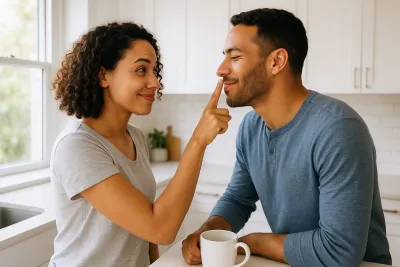
Somewhere in an airport right now, two people are saying goodbye at a gate. Watch the last two seconds before their lips meet: both heads tip to the right, smooth as choreography. They never discussed it. Neither did you, the last time you kissed someone.
Why do we tilt our heads when we kiss? The quick answer is collision avoidance: your nose sits directly in front of the territory your mouth is trying to reach, and tilting lets two noses slide past each other instead of meeting like bumper cars. But the direction is where it gets strange. Two out of three people tilt right. You most likely picked your side before you were born. And we know all of this because a neuroscientist spent months watching strangers kiss in airports.
Let me explain.
Why we tilt our heads when we kiss at all
Hold your head perfectly straight and try to kiss someone doing the same. You can't. Not really. Your noses arrive first, squash together, and your mouths end up negotiating from a distance. The human face put its most protruding feature exactly where it causes maximum trouble.
Tilt your head fifteen or twenty degrees, though, and the geometry resolves itself. Your nose slips past their cheek, theirs slips past yours, and your mouths line up with nothing in the way. That's the entire reason the tilt exists. It isn't a style choice. It's architecture.
(If your nose still feels like a third wheel even with a decent tilt, I wrote a full guide on what to do with your nose when kissing. Short version: the tilt does ninety percent of the work. The rest is trusting it.)
The interesting question was never why we tilt. It's why almost all of us tilt the same way.
The scientist who lurked in airports
In the early 2000s, a German neuroscientist named Onur Güntürkün took on one of the more enviable data-collection jobs in science: he hung around airports, train stations, beaches, and parks in the United States, Germany, and Turkey, and watched people kiss.
He had rules. The kiss had to be on the lips, face to face. No luggage in anyone's hands, since a heavy bag could force a lean. Both partners standing. When a kiss qualified, he recorded exactly one thing: which way the heads turned.
The final count: 64.5 percent of couples turned their heads to the right. Roughly two rightward kisses for every leftward one, holding steady across three different countries.
Your first instinct might be the same as mine: maybe we all just learned it from the movies. Every film poster and rom-com climax could be quietly teaching us the same lean. Scientists wondered that too, so a research team went somewhere Hollywood couldn't reach: Bangladesh, where kissing in public is a cultural no-go and kisses are routinely cut from films and television. Couples there had nothing to imitate. The researchers asked married couples to kiss privately at home and report the details.
Two-thirds turned right anyway.
Whatever pushes us rightward, it isn't the movies. It's in us.
You picked your side before you were born
Here's the part that genuinely delights me. In the final weeks of pregnancy, most babies already prefer turning their heads to the right. Lay a newborn on their back and about 65 percent will turn their head right, roughly 15 percent will turn left, and the stubborn rest refuse to commit. That's almost exactly the 65 percent we see at the departure gate thirty years later.
The head tilt you kiss with, in other words, may be one of the oldest habits you own. Older than your signature. Older than your accent. Older, technically, than you. You started rehearsing your first kiss in the womb; you just had to wait a couple of decades for a scene partner.
Handedness runs through this too. When researchers in that Bangladesh study looked closer, right-handed kiss initiators leaned right and left-handed initiators leaned left. The tilt seems wired into the same left-right division of labor your brain uses for everything from signing your name to holding a fork. About nine in ten of us are right-handed, and the kissing numbers follow like a shadow.
Romance leans right, tenderness leans left
Before you crown the right tilt as the universal law of affection, the science has one more wrinkle for you.
The rightward bias shows up strongest in romantic kissing. Change the relationship and the lean changes with it. Mothers around the world overwhelmingly cradle babies on the left side, a bias so consistent it shows up in centuries of paintings. Watch parents kiss their children and the same leftward drift appears.
One leading theory: the right half of your brain does most of the heavy lifting when you read emotion, and it's wired to the left side of your body and your left field of view. Keeping a child toward your left may keep them in the half of your attention that's best at feeling. A romantic kiss seems to ride a different circuit: more decision, more approach, more go-and-get-it, which researchers suspect ties into the left hemisphere and everything it runs.
Hold that thought the next time a forehead kiss lands differently than a kiss on the mouth. Different kinds of affection literally approach from different angles.
Which way should you tilt your head?
Enough theory. You're leaning in tonight and you want the practical playbook. Here it is.
- Default right. Two out of three people share the instinct, so going right gives you the best odds of a clean, symmetrical landing with someone new.
- Whoever initiates sets the direction. In observed kisses, the person leaning in picks the angle and the other person mirrors it, regardless of their own preference. Kissers who fought their partner's direction described it as instantly awkward. Initiating? Commit to your side early and clearly. Receiving? Match them. That's the entire dance.
- Telegraph it slowly. A slow approach gives your partner a full second to read your angle and mirror it. Most collisions aren't caused by choosing the wrong side; they're caused by arriving too fast for anyone to adjust. This is half of kissing someone for the first time in general: slower is smoother.
- Don't switch mid-flight. Changing sides six inches out is how noses get hurt. If you picked wrong, you'll know, and you can fix it with a smile.
And once you're lined up, remember what the alignment is for. A good tilt gives your mouths full, even contact, and your lips are some of the most sensitive real estate on your body. The tilt isn't a formality. It's what lets all that hardware actually touch.
When your angles don't match
Sooner or later you'll lean right and meet someone from the leftward-leaning third of humanity, both noses tracking the same piece of airspace. A soft bump. A startled laugh. Congratulations: you've had the most common kissing accident on Earth.
Here's what matters: a nose bump is a handshake mix-up, not a verdict. Pull back an inch, smile, and go again. The second attempt is almost always smooth, because now you've both read each other's angle. Some genuinely great first kisses start with a laugh, and if the near-miss rattles you, first kiss nerves matter less than you think.
Add a serious height gap and the geometry gets more creative; kissing with a height difference has its own physics worth knowing. But the recovery move never changes. Slow down, re-tilt, continue.
One tilt in a whole body of instincts
The head tilt is a single entry in a long list of things your body already knows how to do mid-kiss. Your eyes close without being told. Your breathing syncs. Your pulse climbs before your lips even touch. The science of kissing is full of these quiet systems running under the surface, and the tilt might be the oldest of them all: a reflex you packed before birth and have been carrying ever since.
Which means the next time you lean in, you can skip the geometry entirely. Tip right, arrive slowly, and let a habit older than you are take it from there.
Frequently Asked Questions
Which way do most people tilt their head when kissing?
To the right. In the original observational study of couples kissing in public places, 64.5 percent turned their heads right, a roughly two-to-one split that later research replicated in other cultures. The bias even appears in places where kissing is never shown in films or television, which means we don't copy it from movies; it appears to be built in before birth.
What should you do if you both tilt your head the same way?
Pull back an inch, smile, and go again. A nose bump is a timing mix-up, not a sign of bad compatibility, and the second attempt is almost always smooth because you've both now read each other's angle. To prevent it entirely, lean in slowly: whoever initiates the kiss sets the direction, and a slow approach gives your partner time to mirror it.
Does being left-handed change which way you tilt when kissing?
Often, yes. When researchers studied kissing couples, right-handed initiators tended to lean right and left-handed initiators leaned left, which suggests the tilt runs on the same brain wiring that sets your dominant hand. The person receiving the kiss usually mirrors whatever the initiator does, though, regardless of their own handedness.
Do we tilt our heads for cheek kisses too?
Yes, but the pattern changes with the relationship. Cheek-kiss greetings follow local custom more than instinct; in France, which cheek you start on varies from city to city. And affectionate kisses, like a parent kissing a child, actually drift left rather than right, possibly because the brain's right hemisphere, which specializes in reading emotion, monitors the left side of space. Romance leans right; tenderness leans left.