Somebody kissed the top of your head. Maybe it happened mid-hug, your cheek against their chest, and you felt it more than saw it: a small press of lips into your hair, there and gone before you could react. Nobody teaches you what that one means. So here you are, possibly at a strange hour, trying to decode a kiss that never touched your lips.
Good news. This one decodes beautifully.
A kiss on the top of the head is a gesture of protection, comfort, and deep affection. It usually means the person feels a tenderness toward you that runs deeper than attraction: they want you close, they want you safe, and they wanted to say so without making a production of it. Of all the kisses a human being can give you, this is the one that asks for nothing back.
That's the short version. Stay for the long version, because the details (who did it, when they did it, and what their arms were doing at the time) change the answer in ways worth knowing.
Why a kiss on the head feels different from every other kiss
Think about what has to be true for this kiss to even happen.
You're close enough to be inside their arms. Your head is somewhere near their collarbone, which means you're hugging, or curled against them on a couch, or being held while you talk about something that matters. You probably can't see their face. And in most positions, you physically cannot return the kiss without reorganizing your entire body.
That last part is the whole secret. I call it the Unreturnable Kiss.
A lip kiss is a conversation: I lean, you lean, we meet in the middle. Even a great one has a little performance in it, a call and response. A head kiss is a monologue. The giver knows you can't reciprocate. They know you might barely register it. They did it anyway, which means it wasn't for them.
It was for you.
Kisses that expect nothing in return are rare. Pay close attention to the people who hand them out.
Head kiss vs. forehead kiss: cousins, not twins
People use these two interchangeably, and they shouldn't, because the geometry tells two different stories.
A forehead kiss happens face to face. The kisser sees your eyes before and after. It's deliberate, almost ceremonial: a declaration you get to watch being made. I wrote a full guide to what a forehead kiss means because it carries its own weight.
A kiss on the top of the head lands where you can't see it. Half the time it happens when you're distracted, or mid-sentence, or nearly asleep. Which gives us the cleanest way I know to tell them apart:
A forehead kiss says, I want you to know I adore you.
A head kiss says, I adore you whether or not you ever find out.
Both are tender. One is a speech. The other is a note slipped into your coat pocket for you to find later.
Who gave it changes what it says
The same kiss means different things from different mouths. Here's the honest breakdown.
From someone you're dating
Early in a relationship, a head kiss is a tell, and a big one. Attraction has a script: lip kisses, hand holding, the choreography everyone knows. A kiss pressed into your hair is off-script. It means their feelings have outrun the standard moves and started improvising. Most people don't even notice themselves doing it, which is exactly why you should notice it. If you're still in the decoding phase with someone, I keep a full field guide to the signs someone wants to kiss you; the head kiss belongs on the far end of that spectrum, past wanting, into cherishing.
From a long-term partner
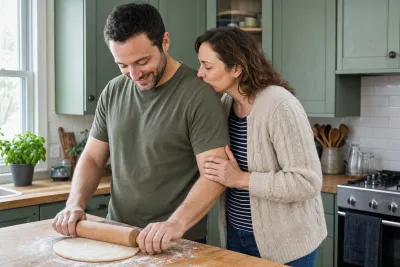
In an established relationship, the head kiss is the native language of settled love. It shows up in the small rituals: pressed into your hair while you pour coffee, on the way out the door, while you're reading and they're passing behind the couch. This is what affection sounds like after the fireworks phase, and couples who keep this current running tend to keep everything else running too.
From a friend
Usually: big-sibling energy. Comfort after bad news, celebration after good news, a lid placed gently on a long hug. Most friend head-kisses are exactly what they look like, protection without romance. The exception is the one that lingers. If a friend's lips stay in your hair for a beat too long and their breathing changes, the kiss may be carrying more than friendship. Don't interrogate the kiss alone; read it next to everything else they do.
From family
This is the original. Parents kiss the crowns of tiny heads for years before those heads can understand it, which is precisely why the gesture reads as safety for the rest of our lives. When a partner kisses the top of your head, part of what your nervous system hears is that ancient message: someone bigger than the problem is here, and you can stand down.
The same kiss in five different moments
Context does the heavy lifting. Here's what the moment around the kiss tells you:
- Mid-hug, unprompted: pure overflow. They had more affection than the hug could hold and it escaped through the top of your head.
- While you're upset or crying: it means I can't fix this, but I'm not going anywhere. It's the physical version of staying.
- When they think you're asleep: the most honest kiss there is. Nobody performs for an unconscious audience. If you've ever half-woken to one of these, you already know everything you came here to learn.
- In passing, at the kitchen counter or your desk: domestic shorthand. Drive-by devotion. The relationship equivalent of a message that just says thinking of you.
- During an apology or a hard conversation: tenderness trying to hold the bridge while words do repairs. Sincere when it comes with changed behavior. Suspicious when it arrives instead of changed behavior.
When a head kiss is not a good sign
Let me be direct, because I know some of you searched this with a knot in your stomach: he kissed my head instead of kissing me. Is that a downgrade?
Usually, no. In healthy relationships, head kisses live alongside lip kisses, not instead of them. One is desire, one is devotion, and a good relationship speaks both languages fluently.
The signal worth watching is substitution over time. If head kisses, cheek pecks, and shoulder squeezes have quietly replaced real kissing altogether, that's not a verdict on you, but it is data. Affection is still present; intimacy is retreating. That drift is common, it's fixable, and I wrote about exactly why couples stop kissing and how to reverse it.
There's also a rarer, sourer version: the patronizing head kiss. It arrives mid-argument, lands like a pat on the head, and is meant to end the conversation rather than hold you through it. You'll know it by how it feels: being handled instead of being held. Trust that feeling. The gesture is identical; the message is not.
How to respond to a kiss on the head
First rule: don't break the moment. A head kiss isn't a question, so it doesn't need an answer. Melt half an inch deeper into them. Squeeze whatever your arms are around. A small contented hum outranks any sentence you could say.
Save the words for later. A casual I love when you do that, delivered hours after the fact, is rocket fuel. People repeat what gets received well; you'll have planted a garden of these things.
Want more of them? Put your head where kisses land. Sit against their shoulder instead of across the room. Step all the way into hugs instead of half-committing. Tall-and-short pairings have a natural head-kiss advantage here, and if that's you, my guide to kissing with a height difference turns the logistics into a feature instead of a bug.
And if you want to give one: earn the altitude honestly (a real hug, a couch, a slow moment), then press rather than peck. Lips into hair, a full two seconds, no sound effects required. The head kiss is the easiest advanced move in the entire repertoire: zero technique, all sincerity.
The kiss that wants nothing
Here's what I keep coming back to. Almost every kiss in the full taxonomy of kisses contains a little wanting: wanting closeness, wanting a response, wanting more. The kiss on the top of the head is the exception. It's affection with the transaction removed. It happens when you're not performing, often when you're not even looking, from someone who gains nothing except the pleasure of loving you at close range.
If someone in your life gives you these regularly, you are richer than you think.
Go tell them you noticed.
Frequently Asked Questions
What does it mean when a guy kisses the top of your head?
It almost always signals protective affection: he feels close to you, wants you to feel safe, and is expressing care that goes beyond attraction. During a hug, it means the embrace itself wasn't enough to hold what he was feeling. From most men, this is one of the least calculated gestures in their entire repertoire, which is exactly what makes it trustworthy.
What does it mean when a girl kisses your head?
The same core message: tenderness, care, and comfort with real closeness. Depending on the relationship, it can carry big-sister warmth, quiet romance, or long-settled love. Women tend to deploy the head kiss deliberately, so if she's doing it, she means it.
Is a kiss on the head romantic or platonic?
It can be either, which is why context matters more than the kiss itself. From a partner it's romantic devotion; from a friend or family member it's protective warmth. Read the surroundings: the length of the kiss, the tightness of the hold, and whether it comes with other romantic signals.
Is a head kiss better than a lip kiss?
They do different jobs. A lip kiss expresses desire; a head kiss expresses devotion. Neither substitutes for the other, and a healthy romantic relationship usually speaks both languages. If one has fully replaced the other for a long stretch, it's worth a gentle conversation.
What is the difference between a forehead kiss and a kiss on the head?
Position and visibility. A forehead kiss happens face to face, with eye contact available before and after: a declaration you watch being made. A kiss on the top of the head usually happens during an embrace, where you can't see it coming: affection given without an audience, which is what makes it feel so unguarded.