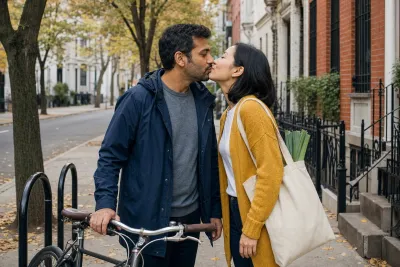
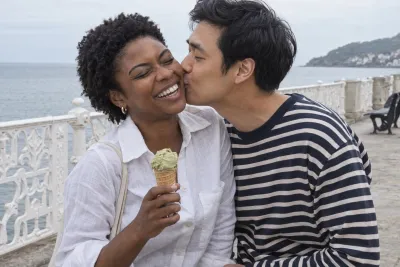
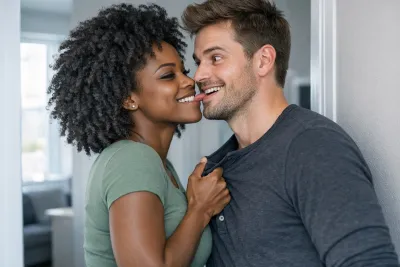
The kiss was going well. Unhurried, a little hungry, the kind where you stop keeping track of whose turn it is to breathe.
Then: teeth. A quick, light catch on your lower lip, there and gone before you could decide how you felt about it.
Now your brain has frozen the frame and is running the replay at quarter speed. Was that on purpose? Was it a move? Was it about you, or is that just how they kiss everyone?
Let me be direct, because you came here for an answer, not a warm-up. When someone bites your lip while kissing, it almost always means desire got a step ahead of good manners. They wanted more than a polite kiss could carry, and their teeth said so. The rest of the meaning lives in three details: how hard it was, when it happened and what they did right after.
Below are the seven things a lip bite can mean, the tells that separate them, what the lower lip versus the upper lip says, and what to do whether you loved it, hated it or are still deciding. (If you're here to learn the move yourself, how to bite a lip while kissing is the step-by-step. This post is the decoder.)
Why a Lip Bite Says So Much
Here's what nobody tells you about the lip bite: it's loud because your lips are built to be loud.
The skin of your lips is only three to five cell layers thick, against up to sixteen on the rest of your face, and it's packed with nerve endings. A pressure your forearm would barely register arrives on your mouth like a headline. (The full anatomy lives in why your lips are so sensitive, and it's worth the detour.)
A kiss also runs on rhythm. Lips meet, part and meet again, and after a few seconds your nervous system settles into the pattern the way you stop hearing a ticking clock. A bite breaks the pattern. Pressure arrives where softness was promised, and your attention snaps straight back to your mouth.
That's why it felt like a statement. Usually it was one. Most people know a bite will be noticed, and very few do it by accident twice.
The 7 Things a Lip Bite Usually Means
These run roughly from most common to least. Most real bites are a blend of the first three.
1. They want you, and it spilled over
This is the big one. Somewhere in the kiss, their wanting outgrew what lips alone could do, and the bite was the overflow. It's the kissing equivalent of squeezing someone's hand a little too hard at the top of a roller coaster.
The tells: it happens when the kiss is already building, the pressure is light to medium, and they pull you closer afterward instead of pulling away. They're not performing. They're just past the point of being polite about it.
2. They're teasing you
A tease bite has a particular shape: catch, a soft tug, release, and a half-inch retreat. They're making you come back for the next one.
It works on the same logic as the teasing kiss, where the almost matters more than the kiss itself. You'll often catch a grin before they come back in. Sometimes the bite is the last thing that happens before they leave, which is its own message: to be continued.
3. They're asking to turn it up
Some people use a bite the way others use a hand sliding to your waist: as a question. More? It's a low-stakes way to find out whether you want the kiss to get hungrier, without saying a word.
You'll know it was a question because they pause, just slightly, to read you. If you lean in, the kiss changes gears. If you soften, a good kisser follows you back down.
4. They're so fond of you it's a little ridiculous
You know the urge to squeeze something unbearably cute? Psychologists call it cute aggression. Yale researchers led by Oriana Aragón published a 2015 study suggesting that these mixed signals help people come down from a wave of overwhelming positive feeling. (Their volunteers were looking at pictures of babies, not partners, which is worth keeping in mind.)
Aragón has said her research wasn't directly about biting partners, but she told VICE that within a loving relationship, "this is a signal of affection." This is the bite that comes with a laugh, or right after they've looked at you like they can't quite believe their luck. Not hunger. Adoration with teeth.
5. It's simply how they kiss
Some people nibble. They nibbled their last partner, they'll nibble their next one, and they'd probably nibble a peach if it held still long enough. For them a bite isn't an event; it's punctuation, the way some people end every text with an x.
The tell is consistency. If it happens early, often and at the same easy pressure every time, you're learning their style, not decoding a message. That's still useful information. It's just a different kind.
6. It was an accident
Teeth happen. A head tilts at the wrong moment, someone moves before the other is ready, and a lip gets caught in the traffic. An accidental bite is usually clumsy rather than crisp: more bump than catch, often with a small clack and an "oh, sorry" laugh.
If it keeps happening, you have a mechanics problem, not a meaning problem, and what to do with your teeth when kissing has the fix.
7. They're not paying attention to you
This is the rare one, and the one worth noticing. A bite that's hard, repeated and indifferent to your reaction isn't flirting. It's someone running a move they saw somewhere, or riding their own momentum, with you as the scenery.
The difference between this and number one isn't the pressure. It's the attention. Someone who's into you watches what the bite does to you. Someone who isn't keeps going after you've flinched.
How to Read a Lip Bite: Pressure, Timing and What Came Next
Every bite answers three questions, and you probably already know the answers, even if you didn't notice yourself noticing.
How hard was it?
- Feather-light, barely teeth: flirting. They're testing, teasing or saying hello.
- Firm but careful: heat. They're turned on and trusting you with it.
- Hard enough to sting afterward: carelessness, at least in that moment. Possibly enthusiasm that outran judgment, possibly a habit nobody has ever corrected.
When did it happen?
- In the first few seconds: confidence, or simply their style. People rarely open with a bite unless biting is part of how they kiss.
- At the peak, while things were building: desire. This is meaning number one in its natural habitat.
- As they pulled away: a tease, and very often a goodbye with a hook in it.
What came next?
This is the tell that matters most, so look hard at the two seconds after the bite.
- They looked at you, smiled, checked your face: they care how it landed. Good sign, whatever the reason.
- They pulled you closer and kept going: desire, and they're hoping you're coming along.
- You pulled back and they didn't pause at all: they weren't reading you.
Handling that tiny pull-back well is a skill of its own; it's one of the ten questions in the Kiss Test, because people answer it in wildly different ways. And it runs both directions. How they responded to your response is the most honest thing a lip bite can tell you.
Lower Lip, Upper Lip or a Little Suction
Where the teeth land adds a shade of meaning, too.
The lower lip
The default target, by a mile. The lower lip is usually the fuller one, and it sits right where the other person's mouth naturally closes, so it's the easiest to catch. A lower-lip bite is the standard dialect, and everything in the seven meanings above applies.
The upper lip
Biting the upper lip takes more maneuvering. They have to change the angle or come at you from slightly below, so it's less likely to be an accident and more likely to be a deliberate, slightly showy move. Read it as intent with a flourish.
Sucking or "swallowing" the lower lip
Sometimes it isn't really teeth at all. They draw your lower lip in between both of theirs and hold it there, with a little suction and maybe the faintest edge of teeth. People often describe it as having their lip swallowed.
It's the same family as the bite, slowed down and turned inward: less playful nip, more absorbed intensity. If it came with a slow pull and release, they're savoring rather than teasing. The movement underneath it is the catch, hold and release at the heart of how to move your lips when kissing; the bite and the suck are that same rhythm with the volume up.
The tug
A bite that catches your lip and gently draws it back before letting go is almost never an accident. It's the most theatrical version and the most openly flirtatious. If you got a tug, you were being flirted with on purpose, and they wanted you to know it.
What It Means When a Guy Bites Your Lip, or a Girl Does
This question gets typed both ways, constantly, as though men and women bite for different reasons. They mostly don't. The seven meanings apply to everyone. What changes the reading far more than gender is how well the two of you know each other.
When a guy bites your lip
From a boyfriend, it's usually desire with a side of familiarity: he knows your mouth, he's fairly sure you like it, and he's stopped being careful. From a guy you've just started seeing, it usually means he's very into you and testing whether the kiss can get hungrier. If he bites hard on a first kiss, he may simply have picked up the move from a movie and skipped the part about reading the other person.
When a girl bites your lip
Same range, same reasons. The tired script says one person escalates and the other gets persuaded, and a lip bite from her tears that script up. Most of the time it means she's enjoying herself and wants you to know it. From a girlfriend, it can also be a dare: keep up.
From someone you're not official with
A bite is proof of wanting in that moment, not a relationship status. It tells you the attraction is real. It doesn't tell you whether they'll text tomorrow. If you're replaying one particular kiss with one particular person, signs the kiss meant something to him is a better lens than any single move, and the same signs work whoever kissed you.
How to Respond to a Lip Bite
If you liked it
Tell them, and you don't need words. A sound you didn't plan, a hand that pulls them closer, a smile against their mouth: any of these lands as yes, again. If you'd like to give one back, keep it a notch softer than what you got. Bites tend to escalate when they're traded, so let the person who started it set the ceiling.
If you'd rather use words, afterward is perfect. "When you bit my lip? Do that again." Nobody in history has been sorry to hear that sentence. And if you tend to freeze when someone else takes the lead, how to kiss back covers following without stalling.
If it was too much
You're allowed to like the idea and not the pressure. Most people adjust instantly when told, because most people would much rather know.
In the moment, keep it light:
- "Softer."
- "Easy, tiger." (Corny. Works anyway.)
- Or ease back half an inch, smile, and come back in with a slower kiss. You've reset the pace without saying a word.
Afterward, if it keeps happening:
- "I like a little bite. A little. Last night was a lot."
- "Biting isn't really my thing, but everything else you were doing? Keep doing it."
The kind scripts in how to tell someone they're a bad kisser work just as well for one habit as for a whole kiss, and nobody has to feel like they failed an exam.
If it broke the skin
Even a small nick on the lip deserves a minute of care. MedlinePlus, the U.S. National Library of Medicine's health site, advises washing a human bite with mild soap and warm running water, and seeing a provider as soon as possible for any bite that breaks the skin. It also says to get help if the bleeding doesn't stop after a few minutes, or if you notice swelling, redness or pus.
Then have the "softer, please" conversation. A bite that draws blood earns that conversation every time, however good the kiss was.
If you asked them to stop and they didn't
That isn't a kissing style. Asking someone to ease off and having them carry on is a boundary being ignored, and it tells you something important about the person that has nothing to do with lips. You don't owe anyone another round to find out whether they'll listen next time.
Should You Bite Back?
Only if you want to, and only after reading what you got.
- Match the spirit, not the force. If theirs was playful, keep yours playful. If theirs was a slow, savoring pull, answer in kind.
- Go a notch lighter. Your teeth don't know their lips yet. Start softer than you think you need and let their reaction tell you whether to add more.
- Stick to the lower lip at first. It's the easy target and the expected one. Save the upper lip for when you know each other's mouths.
- Watch their face afterward. Run the same two-second check you just ran on them. Did they smile, lean in, do it back? Then you've found a shared language.
For the mechanics of pressure and the three levels of bite, the lip-bite guide goes step by step. And if you'd like to calibrate before you try it on a person, the back of your own hand is a fair place to learn how hard you actually press, which is the one thing hand practice is genuinely good for in how to practice kissing.
The Bottom Line
What does it mean when someone bites your lip while kissing? Usually that they wanted you a little more than a careful kiss could hold. Sometimes it's a tease, a question or simply their signature. Once in a while it's someone who isn't paying attention.
You won't decode it from the bite alone. Read the pressure, the timing and, above all, the two seconds afterward: whether they looked at you to see how it landed. A bite from someone who's watching your face is a compliment. A bite from someone who isn't is just teeth.
Frequently Asked Questions
Is it a good sign when someone bites your lip while kissing?
Usually, yes. A light bite during a kiss almost always signals desire, playfulness or an invitation to turn the kiss up. It stops being a good sign when it's hard, repeated and ignores how you react.
What does it mean when a guy bites your lower lip while kissing?
Most often that he's turned on and wants the kiss to get hungrier. A soft tug that ends with him pulling back is usually a tease. If it's hard, or keeps happening after you flinch, he isn't reading you, and it's fine to tell him "softer."
What does it mean when a girl bites your lip while kissing?
The same things it means from anyone: desire first, then teasing, an invitation for more or plain affection. Most of the time it means she's enjoying herself and wants you to know it.
Why do people bite lips when kissing?
Lip skin is thin and full of nerve endings, so a little pressure registers strongly, and a bite breaks the rhythm of a kiss in a way the other person can't miss. People use it to show desire, to tease, to escalate, out of affection or simply out of habit.
Is it normal to bite lips while kissing?
Yes. Light lip biting is a common part of kissing for plenty of couples. What matters is that you both enjoy it and the pressure stays light enough not to hurt.
What does it mean when someone sucks your lower lip while kissing?
It's a slower, more absorbed cousin of the bite. Drawing your lower lip between theirs usually means they're savoring the kiss and leaning into intensity rather than teasing.
What does it mean when someone bites their own lip before kissing you?
A person biting their own lip while looking at you is widely read as attraction or anticipation, though it can also be nerves or plain habit. Fifty Shades of Grey made Anastasia's lip-biting habit a recurring source of tension for a reason. Watch their eyes: a lip bite paired with a lingering look at your mouth is about as close to an invitation as body language gets.
What should you do if someone bites your lip too hard?
Say "softer" in the moment, or pull back and reset with a slower kiss. If the bite broke the skin, wash it with mild soap and warm running water and see a provider as soon as possible, which is MedlinePlus's advice for any bite that breaks the skin.