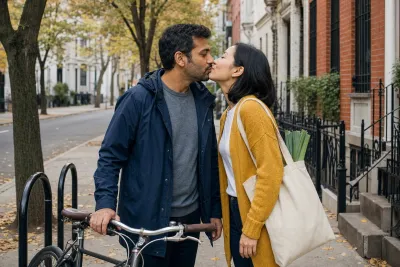
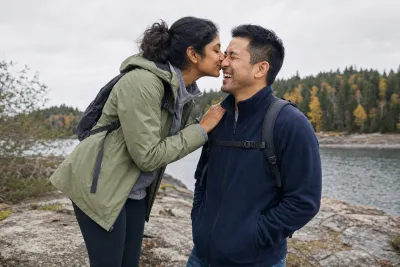
The evening went well. At the door, or the car, or the top of the subway stairs, there was a hug and then a goodbye kiss that should have gone to your cheek.
It didn't quite get there. It landed at the corner of your mouth, half on your lip and half on your skin, and it stayed a beat longer than a goodbye needs.
Then they said goodnight as if nothing unusual had happened. And here you are, searching what a kiss on the corner of the mouth means, replaying half a second on a loop.
You're in good literary company. In Peter Pan, J.M. Barrie gave Mrs. Darling a mouth with "one kiss on it that Wendy could never get, though there it was, perfectly conspicuous in the right-hand corner." More than a century later, the corner of the mouth is still the most mysterious square centimeter on the human face.
Here's the short version. A kiss on the corner of the mouth usually means someone wanted more than your cheek but wasn't sure they were allowed your lips. It's a question. Sometimes it's an accident, and sometimes it's the answer to a question you asked. The rest of this page is how to tell which.
What a kiss on the corner of the mouth usually means
Think of the face as a map with a border running through it. The cheek is friendly territory: grandparents, old friends, half of Paris saying good morning. The lips are romantic territory. The corner of the mouth is the checkpoint where the two meet.
Anatomically, it's the spot where your upper and lower lips join and hand off to ordinary cheek skin. A kiss there touches lip and skin at once, and your lips are some of the most touch-sensitive skin you have. That's partly why a kiss landing a centimeter off-center can feel like an event.
When it's deliberate, standing on that border is the whole point. The kiss says I'd like to cross, and I'm leaving the next step to you. It's more loaded than a kiss on the cheek and less committed than a kiss on the lips, and it leaves both people a graceful exit.
That exit is exactly why people use it. If you lean in, the next kiss is probably on your mouth. If you don't, they can let it pass as a cheek kiss that drifted, and nobody has to have an awkward conversation on the doorstep.
First, ask who moved
Before you decode anything, replay the geometry. A kiss lands on the corner of the mouth for one of three reasons, and they mean very different things.
They aimed there
Their head stayed on course, yours stayed still, and their lips arrived precisely at the corner. This is the deliberate version, and it's the one most people are really asking about. Getting a mouth to that exact spot takes aim, so it's rarely random. The four meanings further down are all versions of this one.
You turned your head
Did they come in for your lips while you turned, even slightly? Then the corner of the mouth is simply where a lip kiss lands when it gets redirected. From their side of the moment, your turn read as not yet, or maybe not you.
If that's what you meant, good: your body said it clearly and kindly. If it was a reflex (nerves, surprise, a bad angle), they probably don't know that. A quick "sorry, you caught me off guard" with a smile will fix it faster than a week of wondering.
It works in reverse, too. If you went for their lips and got the corner because they turned, you have your answer, and it arrived politely. Take it gracefully and give it time.
You both moved
The comedy version. You went in for a cheek greeting, they went the same way, and two faces tried to share one lane. Somebody gets the corner of a mouth, and usually both of you laugh.
This happens more than you'd think, because people don't all turn the same way. When a psychologist watched 124 couples kissing in airports, train stations, beaches and parks in the United States, Germany and Turkey, about two-thirds turned their heads to the right. The other third went left. Add a greeting where one cheek goes first, a height difference and a glass of wine, and near misses are inevitable. (Why we tilt our heads when we kiss covers the whole collision problem.)
A slip is fast, often comes with a sound (an "oops," a laugh, an apology), and changes nothing about how they act afterward. Treat it as what it was: a traffic accident at walking speed.
When it's on purpose: the four meanings
If they aimed, the kiss is saying one of four things. The relationship and the moment tell you which.
The question: "Can I?"
The classic. It shows up at the end of a date or a long night of talking, usually from someone who has been giving you other signs they want to kiss you. The kiss lingers for a second or two. Then they pull back only a few inches and look at you, maybe at your mouth.
That pause is the question mark. They've gone most of the way and left the last bit to you.
Hitch fans will recognize the move. In the 2005 film, Will Smith's date doctor teaches the 90/10 rule: go 90 percent of the way, then hold until the other person comes the last 10. A kiss on the corner of the mouth is the 90 percent with a little extra courage built in.
The hedge: "I want to, but I don't want to be wrong"
A cousin of the question, with more nerves in it. It's quicker, the eye contact afterward is short, and they often start talking immediately, a little too brightly, about the parking or the weather or anything at all.
You'll see it most between friends who are drifting toward something more (if that's you, how to kiss a friend covers the rest), or on an early date when someone has read your signals as a solid maybe. The interest is real, and so is the fear of misreading you. Be kind to it.
The tease: "Come and get the rest"
This one belongs to couples and to people who already know the answer is yes. It's slower, and it's deliberately incomplete. They kiss the corner of your mouth, maybe drift along your jaw, and pull away smiling while you're still leaning in.
Your lips are right there and they are choosing not to take them. That's the opening move of the kiss migration in how to tease with a kiss, and the correct response is usually to go and collect what you're owed.
The everyday corner: "Hi, I love you, I'm busy"
Long-term partners give this one constantly without thinking. You're mid-sentence, or chewing, or on a call, or carrying a laundry basket, and they plant a quick kiss on whatever part of your mouth is available. Usually that's the corner.
It doesn't need decoding. It's affection that didn't want to interrupt you. If it's the only kind of kiss you get these days, that's a separate conversation, and why couples stop kissing is a good place to start it.
How to tell a slip from a signal
When you're replaying the moment, these are the details that separate an accident from an invitation:
- Aim. Near the corner happens by accident. Exactly on the corner, lips placed rather than bumped, rarely does.
- Duration. A slip is over in well under a second. A signal stays for a beat or two.
- Pressure. An air kiss or a bump says greeting. A real press of the lips says they meant to be there.
- The retreat. After a slip, people step all the way back. After a signal, they pull away a few inches and stop.
- The eyes. A glance at your mouth afterward is the most honest tell there is. A glance at the floor followed by fast talking is the hedge.
- The hands. A hand on your jaw, your waist or the back of your neck turns a corner kiss into a clear statement. A pat on the shoulder undoes it.
- The setting. At a crowded party where everyone greets with a kiss, a slip is likely. At your door at the end of a date, it almost certainly isn't one.
- The sequel. Once can be an accident. Twice is a pattern. If it happens again next time, stop wondering.
No single clue settles it. Two or three pointing the same way usually do.
What it means from a guy, a girl, a friend or a partner
People search what it means when a guy kisses the corner of your mouth, and separately what it means when a girl does. The decoder above doesn't change with gender. Aim, duration, retreat and eyes work the same way on everybody. What changes the meaning is who they are to you.
- From someone you're dating: usually the question or the hedge. They're interested and checking whether you are.
- From a friend: either a slip (especially in a friend group that greets with cheek kisses) or the hedge. If it's the hedge, your friendship is about to have an interesting week.
- From a partner: the tease or the everyday corner. Both are good news.
- From someone you barely know: where cheek greetings are normal, probably a slip. Otherwise it's a bold move from a near-stranger, and you're allowed to find it charming or too much. A step back is a complete answer.
How to respond to a kiss on the corner of the mouth
Here's what nobody tells you: this is one of the easiest kisses in the world to answer. You don't need a speech. You need to decide what you want and let your face say it.
If you want the real kiss
Stay put. The classic mistake is stepping back out of pure surprise and then spending three days wishing you hadn't.
Hold their eyes for a second. Then turn your face that last inch toward theirs, so your mouth is where the corner used to be. That's the missing 10 percent, and it's all they were asking for. If you'd rather use words, "you missed," delivered with a smile, is a perfectly good opening line.
If nerves freeze you in place (it happens to plenty of people), how to kiss back walks you through the first three seconds.
If you don't
Keep it warm and keep it short. Step back, squeeze their hand or their arm, and say goodnight like you mean goodnight. The distance does the talking.
If they're a friend and you want to stay friends, a little clarity now is kinder than letting them wonder: "I really like you, and I want to keep what we have." If you're interested but want to go slower: "I like you. I'd like to take this slowly." Both are honest, and neither asks anyone to pretend the moment didn't happen.
If you honestly can't tell
Ask. "Was that on purpose?" with a grin is one of the least awkward questions you can ask, because every possible answer is fine. "Yes" means you get to decide. "No, sorry!" gets you a laugh. "Maybe?" means you're in the same boat, and that's where good stories start.
For what to say and text afterward, what to do after a kiss has the scripts.
How to kiss the corner of someone's mouth on purpose
Maybe you're here from the other side of the question. You like someone, you're fairly sure they like you, and you want a move that asks without cornering them. (Sorry.)
Let me be direct: only use it with someone who has already shown interest, such as lingering eye contact, leaning in, or finding reasons to touch your arm. It's a question, not an ambush. It has no place with a colleague, a stranger or anyone who has been pulling away.
1. Choose a natural moment
Goodbyes are ideal because a kiss is already on the table; you're only changing its address. The end of a date, the doorstep, the hug before someone climbs into a cab.
2. Start as if you're going for the cheek
Come in at cheek-kiss speed, then slow down for the last few inches. The approach should look ordinary. The landing is where the meaning goes.
3. Aim for the seam
Land with the center of your lips at the point where their lips meet their cheek, roughly half on lip and half on skin. Keep your mouth closed and relaxed: no tongue, no suction, no sound effects. If you're wearing lipstick, expect to leave a little evidence at the corner (how to kiss with lipstick on can help with that).
4. Hold one beat
A second, maybe two. Long enough that it can't be mistaken for a slip, short enough that it doesn't turn into a kiss they didn't agree to.
5. Pull back a few inches, then stop
Don't retreat to arm's length. Stay close enough that one small movement from them would turn this into a real kiss, and meet their eyes.
6. Let them answer
If they close the gap, kiss them properly. If they step back, smile, say goodnight and mean it. You asked a question gracefully and got a clear answer, which is more than most people manage on a doorstep.
A height difference makes all of this harder to aim, so the taller person should do most of the bending; how to kiss with a height difference has the angles. And if you'd rather ask out loud, that works beautifully too. How to ask for a kiss has lines that don't sound like a job interview.
The inch that says everything
A kiss on the corner of the mouth lives one inch from a real kiss, and that inch is the message. Most of the time it means someone wants more than your cheek and is politely leaving the choice with you. Sometimes it's a greeting that went off course, a lip kiss you redirected, or a partner being playful on a busy afternoon.
Work out who moved. Read the aim, the pause and the eyes. Then decide what you want, and answer with that last inch or with a warm goodnight.
Either way, you'll have done better than Mr. Darling. According to Barrie, he got all of his wife "except the innermost box and the kiss," and in time he gave up trying.
Frequently Asked Questions
What does a kiss on the corner of the mouth mean?
It usually means someone wants more than a cheek kiss but isn't sure a kiss on the lips is welcome, so they're asking with a kiss. It can also be a greeting that slipped, a lip kiss that landed off-center because someone turned their head, a playful tease, or everyday affection between partners.
Is a kiss on the corner of the mouth flirting?
When it's deliberate, almost always. A kiss placed exactly on the corner, held for a beat and followed by eye contact is flirting. A quick bump during a cheek greeting, followed by a laugh or an apology, usually isn't.
What does it mean when a guy kisses the corner of your mouth?
The same thing it means from anyone. If he aimed there and lingered, he's interested and checking whether you are. If it was fast, happened during a group greeting, or you turned your head as he leaned in, it may have been a slip or a redirected lip kiss.
What does it mean when a girl kisses the corner of your mouth?
The same thing it means from anyone. A deliberate, lingering kiss on the corner usually means she's interested and leaving the next move to you. A quick one during a greeting, followed by a laugh, is more likely an accident.
Does a kiss on the corner of the mouth count as a kiss on the lips?
Not quite, and that's the point. It touches the edge of the lips, so it's more intimate than a cheek kiss, but it stops short of a full kiss on the mouth. Most people treat it as an invitation to one rather than the real thing.
Can a kiss on the corner of the mouth be an accident?
Yes. Cheek greetings go wrong when two people turn their heads the same way, and a lip kiss lands on the corner when one person turns away. Accidents are fast and followed by a laugh or an apology; deliberate ones linger.
How do you kiss the corner of someone's mouth?
Approach as if for a cheek kiss, then land with closed, relaxed lips where their lips meet their cheek. Hold it for a second, pull back only a few inches, and meet their eyes so they can close the gap if they want to. Only do it with someone who has already shown interest.
What should you do if someone kisses the corner of your mouth?
If you want more, stay close and turn your face that last inch toward theirs. If you don't, step back warmly and say goodnight. If you can't tell whether it was deliberate, ask with a smile: "Was that on purpose?"