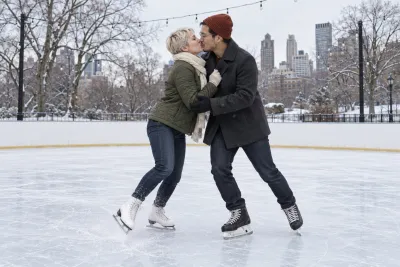
The text arrives at 9:40 on a Friday: come over? we could make out.
And suddenly you're doing linguistics. Make out how, exactly? Kissing? Kissing plus? For how long? Is there an agenda nobody sent you?
Let me be direct. A make out session is a stretch of continuous kissing that lasts minutes instead of seconds, usually with some tongue, plus hands, closeness and kisses that wander to the jaw, neck and ears. By most people's definition it stays clothed and it doesn't include sex. Anything past kissing and over-the-clothes touching is its own conversation, and either of you can slow it down or stop it at any point. Here's what that looks like in real life, from the first kiss that doesn't end to the slightly rumpled aftermath.
What Is a Make Out Session, Exactly?
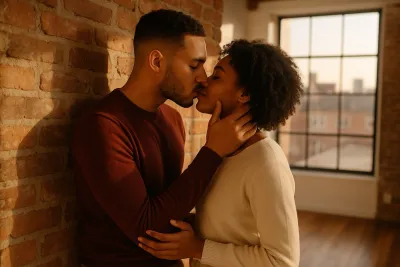
A make out session is kissing that has stopped being a moment and turned into an activity. One kiss leads into the next, nobody pulls away, and before long you've lost count.
The simplest test I know: a kiss has a beginning and an end. A make out session has a middle.
People mix up French kissing and making out constantly, but they're different kinds of thing. A French kiss is one type of kiss. Making out is the whole session, and it usually includes French kisses alongside pecks, slow closed-mouth kisses, pauses, laughing and starting over. I break down that difference properly in French kiss vs normal kiss.
The phrase itself is American and dates back to at least 1949. The rest of the English-speaking world has its own vocabulary for the same pastime:
- Snogging: Britain and Ireland
- Getting off with someone: Britain
- Shifting: Ireland
- Pashing: Australia and New Zealand
- Necking: the vintage term (ask your grandparents, then watch them change the subject)
The 1950s even tried to draw the boundary with a ruler. One 1956 study defined necking as "kissing and light caressing above the neck" and filed anything more intimate under petting. I like to imagine a decade of teenagers arguing about exactly where the neck ends.
What's Included in a Make Out Session
Here's what nobody tells you: there is no official rulebook, which is exactly why so many people go looking for one. Making out means slightly different things to different people, so the most useful way to picture it is a menu. Some dishes come standard, some you order by asking, and some aren't served at this restaurant at all.
Usually on the menu
- Kissing at every speed. Quick pecks, slow lingering kisses, open-mouth kisses and some tongue once you're both relaxed. Tongue comes and goes. It's never the whole show.
- A playful nibble. A slow, light catch of the lower lip between your lips (teeth barely involved).
- Detours. Kisses along the jawline, down the side of the neck, just below the ear. These side trips are a big part of what makes a session feel different from a kiss, and how to kiss someone's neck maps the whole route.
- Hands with somewhere to be. Cradling a face, fingers threading into hair, a palm at the waist or the small of the back, a slow pull closer.
- Getting closer. Knees touching, then sitting pressed together, leaning against a kitchen counter, sometimes ending up side by side on a couch.
- Breaks. Catching your breath, laughing, looking at each other, saying something ridiculous, going back in.
Ask first
This is where couples genuinely differ, and where one quick question saves a lot of guessing:
- Hands under the hem of a shirt, on bare skin
- Shifting from sitting up to lying down
- Anything that leaves evidence, like a hickey
- Making out anywhere other people could walk in on you
None of these are off limits. They're just not assumed. A whispered is this okay? takes two seconds, and it's one of the most attractive questions you can ask mid-kiss.
Not on this menu
Taking clothes off, touching intimate areas, sex. By most people's definition, those aren't making out anymore. They're a different evening with a different conversation.
The slang has always been a little slippery, and some people do use "make out" for more than kissing. That's exactly why it's worth knowing what your person means before you assume anything.
An invitation to make out is an invitation to kiss for a while. It isn't a promise of anything else.
What Actually Happens During a Make Out Session
Movies have oversold this a little. The Notebook gives you one soaked, seamless kiss in the rain with the score swelling behind it. Real ones move more like a tide: they come in, pull back, come in again, and every so often someone's elbow sinks into a couch cushion.
Here's the honest shape of one:
1. It starts as a normal kiss that nobody ends. Almost nobody announces "let's make out now." A goodnight kiss lingers, someone leans back in, and you're in it. 2. It warms up. Kisses get longer and slower, mouths open a little, hands find a face or a waist. Breathing gets louder. That's normal, and it's part of the fun. 3. It finds a rhythm. Intensity rises and falls. You kiss harder, ease off, trail to the jaw, return to the mouth. That variety is what makes ten minutes feel like two. 4. Real life interrupts. Noses bump. Teeth click. An arm goes numb under someone's shoulder. You laugh, rearrange yourselves and carry on. These moments aren't failures; they're proof you're two people rather than a perfume ad. 5. It winds down. Kisses get softer and further apart, until there's one last slow one and a quiet hi from very close range.
How long all that takes depends on where you are, how new you are to each other and what kind of mood you're both in. A few minutes on a doorstep is a make out session. So is most of a rainy Sunday afternoon. How long should a kiss last has the full breakdown, including how to pace a long one so it doesn't turn into a jaw workout.
If you want the step-by-step playbook for every stage (pressure, pacing, the mistakes that flatten the mood), how to make out is the driving lesson. This page is the map.
How to Start a Make Out Session (Without Announcing It)
The best sessions don't come with a press release. Five steps that work almost anywhere:
1. Choose somewhere private with a place to sit. Standing make outs are short by design; your legs and the outside world both get a vote. A couch or a parked car lets you settle in. If one of you is much taller, sitting down levels things instantly, and the height difference guide covers the rest. 2. Close the distance before the kiss. Sit closer than you need to. Let your knee rest against theirs. Body language does half the asking. 3. Start with an ordinary kiss. Closed mouth, unhurried. Use the 90/10 rule from Hitch: go most of the way in and let them close the last little gap. That pause doubles as a real chance for them to choose. 4. Don't end it. When the kiss would normally finish, pull back an inch, look at them and go back in. That second kiss is the real invitation. 5. Match their speed, then nudge. If they lean in and open up, follow. If they keep it light, keep it light. Escalate in small steps, never jumps.
If the moment before the first kiss is the part that freezes you, how to initiate a kiss walks through reading the signals first.
How to Say More, Less or Stop (Without Killing the Mood)
Making out is a conversation held mostly without words, which is lovely right up until the body language isn't enough. Keep a few short lines ready:
- For more: "Come here." "Don't stop." "Can I kiss your neck?" (Specific questions land better than vague ones.)
- For slower: "Slower." "Stay right there." "I like this pace."
- For a breather: "Hang on, I need air." "Wait, I just want to look at you."
- For a limit: "I want to keep kissing you. Just kissing."
- For stopping: "Let's stop here. That was really good."
Either of you can slow down or stop at any point, including in the middle of something you both started happily. A yes to kissing isn't a yes to anything else, and a yes from five minutes ago doesn't run forever. The most self-assured response to let's slow down is "of course," a smile and actually meaning it.
Read the body too. Someone who pulls you closer, kisses back with more intent or slides a hand into your hair is enjoying themselves. Someone who goes still, turns their face away, keeps their hands to themselves or answers in single syllables is asking you to ease off, even without saying a word.
Pace is the habit most people misjudge in themselves, and it shows up fast in a make out. If you suspect you rush, the Kiss Test scores exactly this habit.
What Happens After a Make Out Session
Your face may file a report.
- Puffy, pink lips. Lips are thin-skinned and packed with nerve endings, so they notice every minute of attention, and a long session can leave them looking fuller for a while. Why lips are so sensitive explains the wiring.
- Stubble burn. Pink, prickly skin around the mouth and chin after kissing someone with stubble. It fades, and kissing someone with a beard has the prevention plan.
- Lipstick in unexpected places. Their mouth, their collar, your chin. Check before you walk back into a room full of people.
- Hair that tells on you. Same advice.
- A floaty, giddy feeling. Your body really is doing a lot during all that kissing, and the science of kissing explains what's going on under the surface.
Then there's the emotional part. A session like that can mean a lot or a little, depending on who you are to each other. It doesn't automatically make you a couple, and it doesn't obligate anyone to anything more. What you do in the next ten minutes usually says more than the session did, and what to do after a kiss covers the graceful exit and the "so, that happened" conversation.
Is It Okay to Just Make Out?
Yes. Completely.
Somewhere along the way, making out got demoted to a warm-up act, something to hurry through on the way to somewhere else. That's a shame, because unhurried kissing with someone you like is one of the best ways two adults can spend an evening.
Plenty of people enjoy making out as the destination: new couples who want to take their time, people who simply love kissing more than anything that might follow it, and long-term partners who realize they haven't really made out in months. If you're in that last group, why couples stop kissing explains how the drift happens and how to reverse it.
And if you've never made out with anyone and all of this sounds like a lot, relax. Nobody is born knowing what to do with their hands. How to practice kissing is a low-stakes place to start.
The Bottom Line
A make out session is extended kissing: lips, some tongue, wandering kisses, hands, pauses and laughter, usually clothed and never a contract. It starts as a kiss nobody ends, lasts as long as you're both enjoying it and stops the moment either of you wants it to.
The 10 Kiss Commandments, the free chapter you can grab below, is where I'd start if you want the ground rules that make every one of these sessions better.
Go be late for something.
Frequently Asked Questions
What is considered a make out session?
A make out session is a stretch of continuous kissing that lasts minutes rather than seconds, usually with some tongue, plus touching, closeness and kisses on the jaw, neck and ears. Most people use the term for kissing and over-the-clothes touching, not sex.
Is making out the same as kissing?
Making out is a kind of kissing, but not every kiss is making out. A kiss is a single moment with a clear beginning and end. Making out strings many kisses together, usually including open-mouth and French kisses, hands, pauses and kisses beyond the lips.
Does making out mean having sex?
No. For most people, making out means kissing and touching with clothes on. A few people use the phrase more loosely, so if you're unsure what someone means, ask. Agreeing to make out is not agreeing to anything more.
What do you do during a make out session?
You kiss at different speeds, from pecks to slow open-mouth kisses with some tongue, trail kisses to the jaw, neck and ears, use your hands on their face, hair and waist, and take breaks to breathe, laugh and look at each other before going back in.
Can you make out without tongue?
Yes. Plenty of make out sessions are mostly slow closed-mouth or open-mouth kisses with little or no tongue. What makes it a make out session is the length and the continuity, not the tongue.
What is making out called in the UK?
In Britain it's usually called snogging or getting off with someone. In Ireland people say shifting, and in Australia and New Zealand it's pashing.
Is it okay to stop in the middle of making out?
Yes. Either person can slow down or stop at any point, for any reason. A simple "let's stop here" is enough, and a good partner answers with "of course," not a debate.